
A fillet knife is a specialist's blade: long, thin and flexible, built to glide along the bones of a fish and lift clean fillets with minimal waste. We forge ours by hand in both layered Damascus and rust-resistant 440C stainless, so you can choose the blade that fits how you fish and how much upkeep you want. Every one ships with a handmade leather sheath. These are a specialty part of our wider handmade hunting knives range.
-
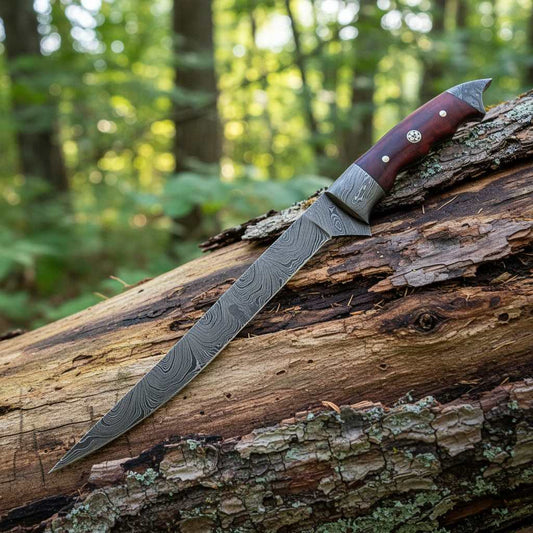
Damascus Fishing Fillet Knife – 7" Blade with Micarta Handle
Precio habitual $130.00 USDPrecio habitualPrecio unitario por$260.00 USDPrecio de oferta $130.00 USDOferta -
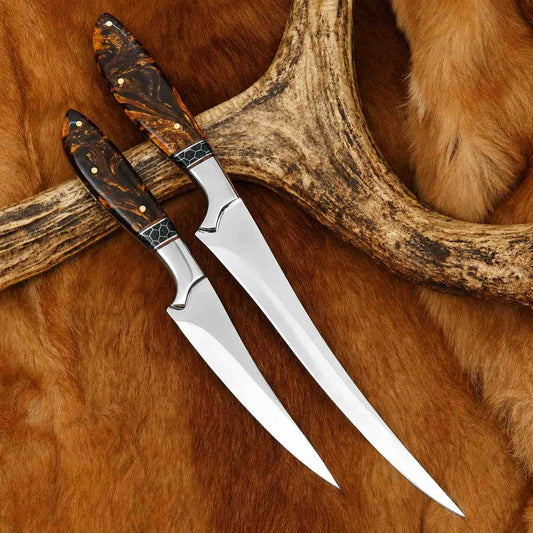
Fillet & Boning Knife Set – 440C Stainless, 2 Piece with Leather Sheaths
Precio habitual $250.00 USDPrecio habitualPrecio unitario por$500.00 USDPrecio de oferta $250.00 USDOferta -
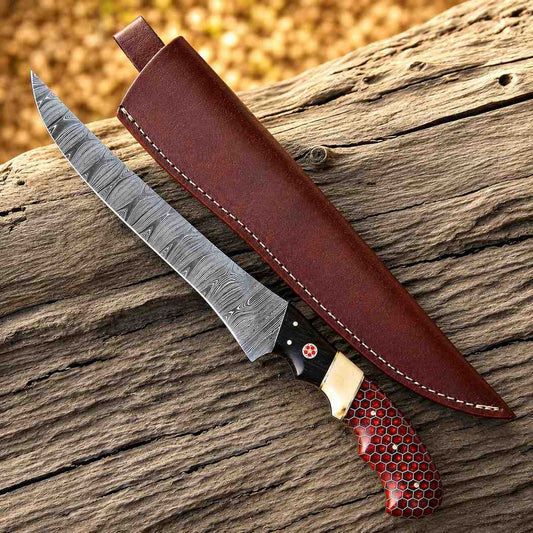
Damascus Fish Fillet Knife – Red Honeycomb & Camel Bone Handle
Precio habitual $125.00 USDPrecio habitualPrecio unitario por$250.00 USDPrecio de oferta $125.00 USDOferta -
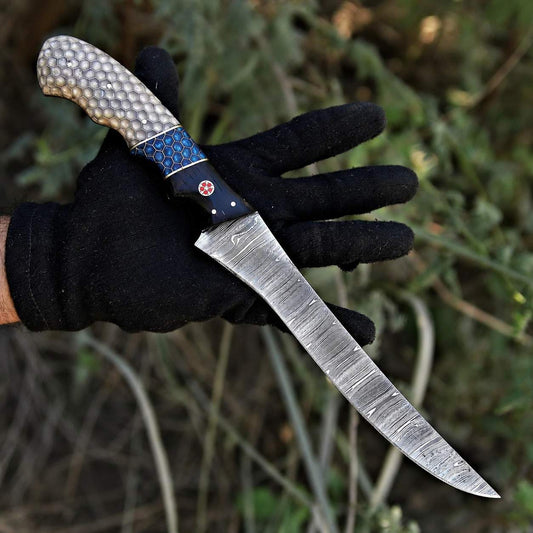
Damascus Fillet Knife – 8" Flexible Blade with Silver Honeycomb Handle
Precio habitual $120.00 USDPrecio habitualPrecio unitario por$240.00 USDPrecio de oferta $120.00 USDOferta




Quick facts:
- Blade lengths of 7 and 8 inches, plus a shorter boning blade in the two-piece set
- Two steels: carbon Damascus in 1095 and 15N20, and 440C stainless
- Flexible blades throughout, ground thin so the edge follows the rib cage
- Full tang construction, with Damascus bolsters on selected builds
- Handles: red and amber resin, micarta, camel bone with honeycomb inlay
- Handmade leather sheath with every knife, several hand-tooled
Who makes these knives?
Every blade here is made by us, Naqash and Younas Minhas, with more than 15 years of combined experience at the bench. Whether you are cleaning a morning's catch at the dock or breaking down fish in the kitchen, a proper fillet knife makes the job faster, cleaner and far less wasteful than a stiff all-purpose blade.
What makes a good one?
The single most important feature is flex. A thin, flexible blade bends to follow the spine and ribs of a fish, separating flesh from bone cleanly so you keep more meat and leave less behind.
Beyond flex, look for a length suited to your fish, longer for big fillets and shorter for panfish and detail work, a handle that grips securely when wet, and full tang construction for strength and balance. Every knife we build is full tang and shaped for real use.
What length and flex do you want?
|
Blade length |
Flex |
Best for |
Weak at |
|
5 to 6 inches |
Flexible |
Panfish, perch, trout, detail work near the collar |
Long fillets, big fish |
|
7 inches |
Flexible |
Walleye, bass, medium fish, the most versatile single length |
Very large fillets |
|
8 inches |
Flexible |
Salmon, pike, larger fish, long unbroken fillets |
Control on small panfish |
|
Boning blade, shorter and stiffer |
Semi-stiff |
Working around bone and joints in meat and poultry |
Following a fish rib cage |
If you are buying one knife, take 7 inches. It handles most freshwater fish and is still controllable on smaller ones. Take 8 inches if you mostly fish salmon or pike, where one long stroke beats three short ones. Anglers who fish a range of species usually end up keeping two lengths on hand.
Damascus or stainless: choosing your steel
We forge these in two very different steels, each with its own strengths.
Side by side:
|
Carbon Damascus (1095/15N20) |
440C stainless |
|
|
Edge |
Takes a keen, aggressive edge |
Very good, slightly less keen |
|
Corrosion resistance |
Low. Will spot if left wet |
High. Built for wet work |
|
Saltwater |
Not recommended without immediate rinsing and oiling |
The right choice |
|
Look |
Unique layered pattern, no two alike |
Clean mirror polish |
|
Upkeep |
Rinse, dry and oil after every use |
Rinse and dry |
|
Best for |
Anglers who want craftsmanship and will maintain it |
Frequent use, saltwater, and anyone who cleans up later |
-
Carbon Damascus. Takes a keen, aggressive edge and carries a striking layered pattern that makes each knife unique. The choice for anglers who want craftsmanship and do not mind a quick wipe and oil after use. See our 8 inch flexible Damascus fillet knife and our Damascus fish fillet knife with a red honeycomb handle.
-
440C stainless. A high-carbon stainless that resists rust and corrosion far better than carbon steel, which makes it the low-maintenance choice for the wet, messy environment a fillet knife lives in. Our 440C stainless fillet and boning knife set pairs a fillet blade with a boning knife for a complete kit.
If you fish often and want the least upkeep, stainless is the practical pick. If you value a forged pattern and a one-of-a-kind blade, Damascus is worth the little extra care, and our Damascus care guide makes that upkeep simple.
Which one is right for you?
- Best grip when wet. The 7 inch Damascus with a red micarta handle. Micarta holds grip through slime and blood better than polished bone or resin, and wet grip is the real risk on a thin flexing blade.
- Largest fish, longest fillets. The 8 inch flexible Damascus. One stroke down a salmon side instead of three.
- Saltwater, or least upkeep. The 440C stainless set. Rinse and dry is the whole routine.
- You bone meat as well as fillet fish. The same set, since it includes both blades and costs less than buying them separately.
- A gift for an angler. The Damascus with red honeycomb and camel bone, the piece people stop on. Choose stainless instead if you know the recipient will not oil a blade.
Caught between two? Send us both through contact and we will tell you which one we would keep.
Fillet or boning knife: what is the difference?
A fillet blade is long, thin and flexible for working along fish bones, while a boning knife is shorter and stiffer for working around bone and joints in meat. Many anglers and home butchers want both, which is why our stainless set includes a fillet knife and a boning knife together.
The practical distinction: flex is an advantage when you are following a curved rib cage and a liability when you are pushing against a joint. A boning knife is stiffer so it can take that push without bending away from where you aimed it. Using one for boning work is the fastest way to put a permanent bend in it.
For more on choosing the right blade for a task, our guide to knife types is a helpful read.
How do you care for it?
These work in a wet, demanding environment, so a little care keeps them performing. Rinse and dry the blade after every use. For carbon Damascus blades, add a light coat of food-safe oil before storage to prevent rust, and our guide to caring for a Damascus steel knife walks through the routine. Stainless blades need far less, just a rinse and dry.
Why buy from Malika Knives
Every knife here is forged, ground and finished by hand by us, Naqash and Younas Minhas. We do not mass-produce, and each knife is paired with a handmade leather sheath. Custom work is available on blade length, flex, steel, handle material and sheath finish. Read more about how we work on our About page, and reach out any time if you would like help choosing the right blade or a custom build.
Carry and transport
These live in a tackle box or a kitchen rather than on a belt, but transport rules still apply.
In the United States, fixed blades in this size range are legal to own, with carry regulated at state and municipal level. Many states treat transport to and from fishing as distinct from general public carry, so keep it sheathed and stowed in your tackle box or vehicle rather than carried on the person.
In Canada, fixed blades are legal to own, with prohibited classifications turning on the opening mechanism rather than blade length.
In the United Kingdom and EU, ownership is legal and fishing is among the recognised reasons for transporting a fixed blade. Confirm current import and age-verification rules before ordering.
Rules change. Verify current law where you fish.
Frequently asked questions
What is a fillet knife used for?
It removes the skin and bones from fish, lifting clean fillets off the rib cage with minimal waste. Its thin, flexible blade follows the contours of the fish, which is what makes it better at the job than a stiff all-purpose knife.
What makes a good one?
The most important feature is a thin, flexible blade that bends to follow the bones of a fish. A good one also has a blade length suited to your fish, a handle that grips when wet, and full tang construction for strength and balance.
Should I choose Damascus or stainless?
Choose stainless such as 440C if you want the lowest maintenance and best rust resistance for frequent wet use, and especially for saltwater. Choose carbon Damascus if you want a forged pattern and a keen edge, and do not mind a quick wipe and oil after each use.
Do Damascus fillet knives rust?
Carbon Damascus is high-carbon steel and can rust if left wet or neglected. Rinsing, drying and applying a light coat of food-safe oil after use keeps it rust-free. Stainless resists rust much more easily.
What size do I need?
A longer blade around 8 inches suits larger fish and long fillets, while a shorter blade gives more control for panfish and detailed cuts. Seven inches is the most versatile single length. Many anglers keep more than one on hand.
What is the difference between a fillet knife and a boning knife?
A fillet knife has a long, thin, flexible blade for filleting fish, while a boning knife is shorter and stiffer for cutting around bone and separating joints in meat. Our stainless set includes both.
Are these full tang?
Yes. Every one is full tang, meaning the steel runs the full length of the handle. That matters on a blade designed to flex, because the bend should happen in the blade rather than at the joint where the blade meets the handle.
Can I use one in the kitchen?
Yes. A flexible blade is excellent for filleting fish, boning and other delicate kitchen tasks. Clean and dry it after use, especially a carbon Damascus blade, and keep it away from acidic food residue.
Do these knives come with a sheath?
Yes. Every knife in this collection comes with a handmade leather sheath, fitted to protect the slim blade for safe storage and transport.
Is 440C good steel for a fillet knife?
Yes, and arguably the best choice for one. 440C is a high-carbon stainless with strong corrosion resistance, which matters more here than on any other pattern because the blade spends its working life wet. It takes a fine edge and sharpens easily.
How flexible should a fillet blade be?
Flexible enough to bend visibly under light hand pressure and spring straight again. That comes from how thin the blade is ground rather than from soft steel. Too stiff and it will not follow a rib cage, too soft and it wanders off the bone under pressure.
