
What Is Copper Damascus Steel?
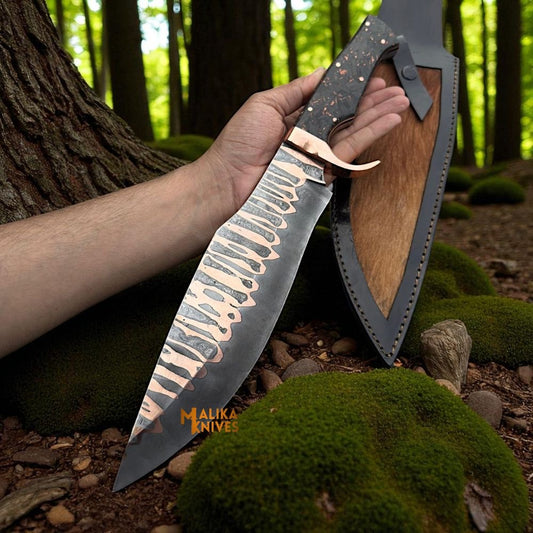
A copper Damascus bowie is a large fixed blade built the same way as Malika Knives' standard Damascus knives, with one addition: real copper forge-welded into the billet, so warm metallic veins run through the etched steel pattern. Every knife in this collection is hand-forged, full tang, and finished with premium handle materials rather than the working synthetics we use elsewhere. A blade is bought to be seen as much as used, so match the piece to the occasion before you choose.
-
Copper Damascus Bowie Knife | Carbon Fiber Handle
Prix habituel $999.00 USDPrix habituelPrix unitaire par$1,500.00 USDPrix promotionnel $999.00 USDPromotion -
Copper Damascus Bowie Knife Handmade Copper Guard
Prix habituel $749.50 USDPrix habituelPrix unitaire par$1,499.00 USDPrix promotionnel $749.50 USDPromotion -

 Promotion
Copper Damascus Alamo Musso Bowie Knife
Prix habituel $1,920.00 USDPrix habituelPrix unitaire par$3,200.00 USDPrix promotionnel $1,920.00 USDPromotion



What Is a Copper Damascus Bowie Knife?
Copper Damascus, also called Cu-Mai or Kumai, builds on centuries-old pattern-welded Damascus by forge-welding real copper directly into the billet alongside high-carbon steel. The copper is heated carefully below its own melting point, then pressed, forged, and etched together with the steel layers, so the copper doesn't just sit on the surface. It runs through the pattern as a genuine structural layer.
The technique was pioneered by Steve Schwarzer, an American bladesmith and founding member of the American Bladesmith Society, who was the first to successfully forge-weld copper with high-carbon steels in the late 1990s. That innovation opened up an entirely new visual register for Damascus work, and it's the legacy of copper Damascus bowies carry forward.
New to the wider Bowie family? Start with Malika Knives' guide to what a Bowie knife is.
How Does Copper Damascus Compare to Malika Knives' Other Bowie Steels?
Copper Damascus sits at the top of the collection for a reason — it trades practicality for presence.
|
Copper Damascus |
Carbon Damascus |
Stainless Damascus |
D2 Steel |
|
|
Construction |
1095/15N20 with forge-welded copper |
1095/15N20 layered |
VG10/15N20 layered |
Single tool steel |
|
Pattern |
Flowing copper veins through etched steel |
Etched steel pattern only |
Etched steel pattern only |
None, uniform |
|
Hardness |
58–62 HRC |
~59–60 HRC |
~59–61 HRC |
~59–61 HRC |
|
Corrosion resistance |
Moderate, needs regular oiling |
Moderate, needs regular oiling |
Good |
Good, semi-stainless |
|
Best at |
Showpiece, gifting, collecting |
Collecting, character |
Field use with pattern |
Hard daily use, low upkeep |
|
Where to look |
Here |
Damascus Bowies |
Damascus Bowies |
D2 Steel Bowies |
The honest read: a plain Damascus or D2 bowie will cut just as well for less money. Copper Damascus is priced and built for buyers who want the single most visually striking blade in the lineup, not the most practical one.
What Is a Copper Damascus Bowie Used For?
- High-end gifting: birthdays, Father's Day, anniversaries, weddings, groomsmen, and business milestones
- Functional field or kitchen use, since every blade is fully hardened and sharpened despite the showpiece finish
- Presentation pieces with engraving and a wooden box for retirement, awards, or heirloom occasions
How Do You Choose a Copper Damascus Bowie?
Work backwards from occasion and budget as much as from the knife itself. Four factors settle it.
Handle material. Carbon fibre gives a modern, technical look against the copper veining. Walnut and camel bone are lean and traditional. Ram horn adds natural variation, with no two pieces identical.
Guard. A copper guard echoes the blade's veining directly and is the most visually cohesive option; a brass or steel guard offers more contrast.
Presentation. If the knife is a gift or heirloom piece, add engraving and the wooden presentation box. A plain leather sheath suits a buyer who wants the blade itself to carry the weight.
Budget tier. The carbon fibre build is the entry point into this collection; the Alamo Musso presentation piece sits at the top and is built as a centrepiece rather than a companion blade.
If the knife is going into a collection or as a gift, prioritise handling material and presentation. If you intend to actually use it, prioritise the guard and confirm the sheath fit before ordering.
Which Copper Damascus Bowie Is Right for You?
Entry point into copper Damascus. The Copper Damascus Bowie with the handmade copper guard is $749.50. Full tang, forge-welded copper pattern, without the premium handle upgrade or presentation box.
Modern, technical look. The carbon fibre handle is built. The copper veining reads differently against a matt technical handle than it does against natural materials, and it ships with a custom sheepskin leather sheath.
The centrepiece of a collection. The Copper Damascus Alamo Musso. The historic pattern and the wooden presentation box make this the piece built to be the focal point of a display rather than one knife among several.
Undecided between two? Send us both through contact, and we'll tell you which one we'd keep.
What Makes Copper Damascus Different in Construction?
Copper Damascus blades are built from a high-carbon steel core, typically 1095 or 15N20, with copper forge-welded between the layers in either a gomai (5-layer) or kumai (7-layer) construction. The billet is heated carefully to stay below copper's melting point, then pressed, forged, and etched, which is what allows the copper to bond into the pattern rather than simply plate the surface.
Every blade we sell as copper Damascus is genuine forge-welded copper, not a surface etch or a laser-printed pattern. Each knife is full tang and tempered to roughly 58–62 HRC, so the showpiece finish doesn't come at the expense of real cutting performance.
Is Copper Damascus Good for Gifting?
Yes, and it's arguably the strongest gifting piece in Malika Knives' lineup. The copper veining is immediately eye-catching even to someone with no knife background, which makes it a natural fit for milestone gifts: birthdays, Father's Day, anniversaries, weddings, groomsmen gifts, and business or retirement milestones.
We offer optional personalised engraving, handcrafted wooden boxes, and custom leather sheaths on these builds, so a copper Damascus bowie can arrive ready to present rather than needing extra wrapping or a separate display case.
How Do You Care for a Copper Damascus Blade?
The 1095 and 15N20 core steels are high-carbon, which means they need the same basic routine as Malika Knives' other carbon Damascus knives, with slightly more attention paid to the copper itself.
- Dry the blade immediately after use.
- Apply mineral or camellia oil after cleaning.
- Never store the knife in a leather sheath long-term leather traps moisture against the steel.
- Never run it through a dishwasher.
- Sharpen with a whetstone or honing rod to preserve the layered edge.
Copper itself won't rust, but it will develop a natural patina over time, which most collectors consider part of the piece's character rather than a flaw. The steel layers still need regular oiling to prevent corrosion. With that care, these knives age well and hold both their edge and their pattern for a lifetime.
Are Copper Damascus Bowie Knives Legal to Own and Carry?
Ownership of a large fixed-blade bowie is legal across the United States, Canada, the UK, and most of the EU. Carry is a separate matter and depends on blade length and local law — these are presentation-grade collector pieces first, so most buyers display rather than carry them, but if you do intend to carry one, check your state statute and any city ordinance beforehand.
In the UK and EU, ownership is typically fine, but carrying a large fixed blade in public without a specific work or sporting reason generally is not. Confirm current import and age-verification rules in your jurisdiction before ordering.
Who Makes These Knives?
Every copper Damascus bowie here is forged and finished by hand by Naqash and Younas Minhas, with more than 15 years of combined experience at the bench. Nothing is mass-produced. Each blade is ground, heat-treated, and fitted individually, then paired with a hand-stitched leather sheath or, in our presentation pieces, a handcrafted wooden box.
Because each piece is made individually, we take custom work on this collection: handle material, guard style, engraving, and presentation options. Send a specification through contact and we'll tell you what's achievable and what it costs.
Written by Naqash Minhas, knife maker, Malika Knives. More about how we work.
Frequently Asked Questions
Are your copper Damascus knives real Damascus or printed?
Every knife is genuine forge-welded copper Damascus, made from layered high-carbon steel and real copper, never laser-etched or surface-printed.
Who invented Copper Damascus?
The technique was pioneered by Steve Schwarzer, an American bladesmith who first forged-welded copper into steel billets in the 1990s.
Will the copper rust or wear out?
Copper won't rust, but it will naturally develop a patina over time. The high-carbon steel layers should be oiled regularly to prevent corrosion.
Can I use these knives outdoors or in the kitchen, or are they just for display?
They're fully functional. Every blade is hardened to 58–62 HRC and sharpened before it ships, so it performs as well as it displays — though given the price point, most buyers treat these as collector or gift pieces rather than daily-use tools.
Do you offer gift packaging or custom engraving?
Yes. We offer personalised engraving, gift-ready wooden boxes, and custom leather sheaths in this collection.
What is Cu-Mai or Kumai steel?
Cu-Mai, also spelt Kumai, is the name for copper Damascus, a pattern-welded blade where copper is forge-welded between layers of high-carbon steel, creating warm, flowing veins through the pattern that standard Damascus doesn't have.
Are your copper Damascus Bowie knives full-tang?
Yes. Each one is full-tang construction, with the steel running the full length of the handle for strength and balance, and tempered to roughly 58–62 HRC for real cutting performance.
What handle materials do you use on copper Damascus bowies?
Carbon fibre, micarta, walnut, camel bone, and ram's horn, often paired with a copper guard to echo the blade's veining. Many builds are available with a handcrafted wooden box and custom leather sheath.
