
Handmade Rambo Bowie Knives
The oversized survival bowie made famous on screen is a real blade pattern: 14 to 16 inches of full-tang steel, a broad clip or spear point, a full guard, and a grip sized for gloves. Malika Knives are made by hand in D2 tool steel with leather sheaths cut for each blade. This knife excels at chopping and batoning but struggles with fine, detailed work; it is best suited for camp and field tasks rather than as a general-purpose knife.
-
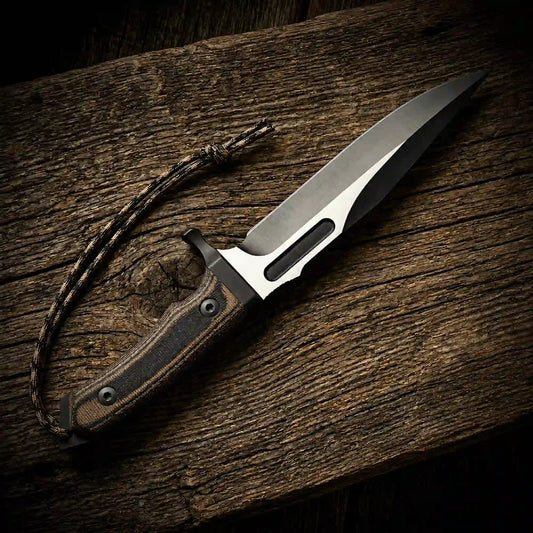
Rambo V Last Blood Replica Bowie Knife – 14" D2 Blade, Micarta Handle
Prix habituel $145.00 USDPrix habituelPrix unitaire par$290.00 USDPrix promotionnel $145.00 USDPromotion -
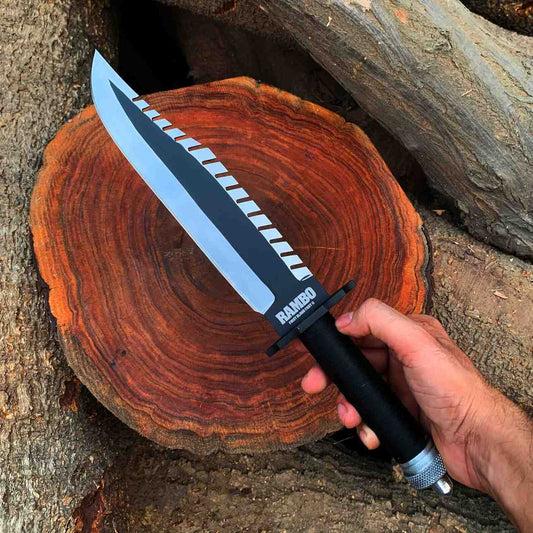
Rambo First Blood Part II Replica Knife – 16" Survival Knife with Leather Sheath
Prix habituel $140.00 USDPrix habituelPrix unitaire par$280.00 USDPrix promotionnel $140.00 USDPromotion -
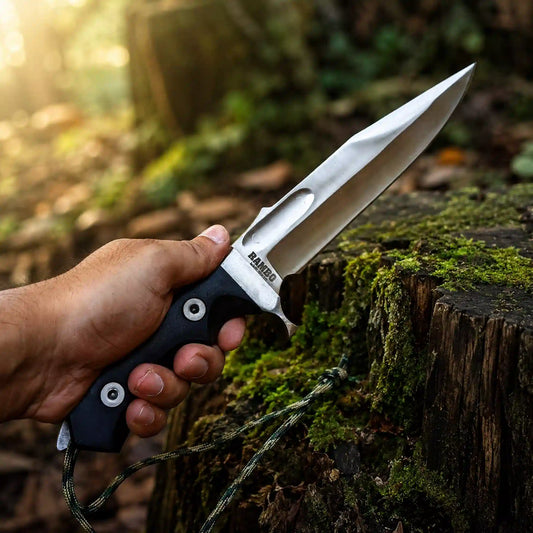
Rambo-Style Survival Bowie Knife – 14" D2 Spear Point with G10 Handle
Prix habituel $155.00 USDPrix habituelPrix unitaire par$310.00 USDPrix promotionnel $155.00 USDPromotion -
Rambo Last Blood Bowie Knife D2 Steel Full Tang
Prix habituel $275.00 USDPrix habituelPrix unitaire par$550.00 USDPrix promotionnel $275.00 USDPromotion -
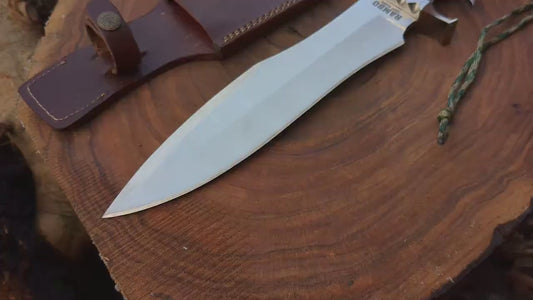
Rambo Bowie Knife D2 Steel Blade - Collectible
Prix habituel $137.50 USDPrix habituelPrix unitaire par$250.00 USDPrix promotionnel $137.50 USDPromotion






Not affiliated, licensed or endorsed. These are Malika Knives own handmade survival bowie designs in the large film-era style. They are not official merchandise and carry no connection to any film studio or rights holder.
- 5 survival bowie knives in stock, from $137.50 to $275
- Blade lengths of 14 and 16 inches, the longest knives we build
- Steel: D2 tool steel across the whole collection, full tang on every model
- Handles: black micarta, G10 with paracord lanyard, cord wrap, and hardwood
- Hand-stitched leather sheath included with every knife, cut to that blade
- Weight sits forward of the guard on all five, which is what makes the pattern chop
What is a Rambo-style survival bowie?
A Rambo-style survival bowie is an oversized fixed blade in the large film-era pattern: a 14 to 16 inch blade, a broad clip or spear point, a full crossguard, and a cylindrical grip long enough for a two-hand hold. The category name comes from the films that made the profile famous in the 1980s, but the underlying shape borrows from military survival knives and frontier bowies that predate them.
Three features define the pattern. Length gives reach and lets the blade chop rather than slice. The full guard matters more here than on a smaller knife, because a long blade in a wet hand generates real forward force. The grip is straight and thick so it works through a glove and takes a second hand for heavy strokes.
How does it compare to other large blades?
Length is not free. The table compares the performance benefits and trade-offs of a 14-inch blade against three common alternatives.
|
|
Survival bowie |
Western Bowie |
Machete |
Bushcraft knife |
|
Blade length |
14 to 16 inches |
8 to 12 inches |
16 to 24 inches |
4 to 5.5 inches |
|
Blade stock |
Thick, rigid |
Medium |
Thin, flexible |
Medium, rigid |
|
Best at |
Chopping, batoning, shelter work |
One blade covering camp and game |
Clearing green vegetation fast |
Carving, feather sticks, fine work |
|
Weak at |
Detail work, skinning, discreet carry |
Heavy chopping |
Hard wood, any precision task |
Chopping, anything heavy |
|
Carry weight |
Heaviest of the four |
Moderate |
Light for the length |
Lightest |
|
Where to look |
Here |
What is a survival bowie used for?
- Splitting kindling and processing firewood by batoning
- Chopping through saplings and limbing for shelter frames
- Clearing brush and trail work
- Digging a fire pit or trench in soft ground
- Prying and levering where a smaller blade would snap
- Striking a ferrocerium rod off the squared spine
- Display and collection, where the profile is the whole point
Where the pattern is the wrong tool: skinning and caping, food preparation, anything needing a delicate point, and any situation where you want the knife to go unnoticed. For field dressing, see Malika Knives skinning knives and gut hook knives. For daily cutting, the folding knives.
How do you choose one?
- 14 or 16 inches. Sixteen chops harder and reaches further. Fourteen is easier to control single-handed and rides a belt without catching. Most buyers are better served at 14.
- Clip point or spear point. A clip point gives a finer tip for detail cuts. A spear point puts more steel behind the tip and makes prying better.
- Handle material. G10 and micarta hold grip when wet and are the practical choice for field use. Cord wrap and hardwood look right on a display piece and are less secure in the rain.
- Lanyard. A paracord lanyard is worth having on any blade you swing. Losing grip mid-stroke on 14 inches of steel is the failure that matters.
- Balance point. Forward of the guard means it chops. Neutral means it handles like a knife. Neither is wrong, but they behave differently.
- Use or display. Be honest about it. A display buyer should optimize for looks and pay less. A field buyer should optimize for handling grip and lanyard.
Which one is right for you?
- You will actually chop it. The 14 inch spear point with G10 and a paracord lanyard. Best grip in the collection when wet, and the spear point takes prying that a fine clip point would not.
- You want the maximum blade. The 16 inch survival bowie. The longest we build, and the one that most closely matches the classic film-era proportions.
- You want the classic look with a working handle. The 14 inch with black micarta. Traditional profile, modern grip material.
- It is going on a wall. The collectible D2 build with a hardwood handle, the entry price in the collection.
- You want the flagship. The heavy D2 survival bowie, the thickest stock and the heaviest chopper here.
Undecided? Send us the two you are weighing through contact and we will tell you which one we would keep.
Why D2 steel on a blade this size?
Every knife in this collection is D2, which is a deliberate choice rather than a default.
D2 is a high-carbon, high-chromium tool steel with strong wear resistance and long edge retention. On a chopping blade that matters more than on a small knife, because you cannot stop mid-task to touch up an edge and because impact work dulls steel faster than slicing does. The roughly 12 percent chromium content makes D2 semi-stainless, so it resists surface rust better than plain carbon steel without being fully stainless.
The trade is sharpening. D2 is best sharpened using a diamond plate, as softer natural stones are often ineffective for this steel. For a knife you sharpen twice a season, that trade is worth taking. For a knife you touch up weekly, layered carbon Damascus is the easier steel, and Malika Knives Damascus Bowie knives cover that. See the full D2 steel Bowie range for other builds in the same steel.
Why does full tang matter on a 14 inch blade?
Full tang means the steel runs unbroken from tip to butt, with the handle material pinned to either side. Every knife here is built that way, and on a blade this long it is not a marketing line.
When you baton or chop, the load concentrates at the point where the blade enters the handle. A partial or rat-tail tang creates a narrow stress point at the guard, which is where large knives often fail under pressure. Hollow-handle survival knives from the same era were known for it, because a threaded joint at the guard is the weakest possible arrangement under lateral force.
How do you sharpen and care for it?
- Use a diamond plate rather than a soft stone. D2 resists abrasion by design, and a soft stone dishes before the edge moves.
- Work the straight section flat at roughly 20 degrees per side. A slightly wider angle suits a chopper, since a thin edge chips on impact work.
- As the contact point reaches the belly, lift the handle gradually so the plate tracks the curve. Lifting too late leaves a dull patch ahead of the belly, the most common fault on this shape.
- Finish the tip last with lighter pressure, then strop on leather to remove the burr.
Are large survival knives legal to own and carry?
Ownership and carry are separate questions, and blade length matters more here than on any other page of this site.
United States
Large fixed blades are legal to own throughout the United States. Carry is regulated at state and often municipal level, and several states set a blade length threshold above which open or concealed carry is restricted. A 14 or 16 inch blade sits above most of those thresholds, so check both your state statute and your city ordinance before carrying rather than transporting.
Canada
Fixed blades are legal to own in Canada, with prohibited classifications turning on the opening mechanism rather than length. Transport sheathed and inside a pack.
United Kingdom and EU
Ownership is generally legal, but a fixed blade of this size is not a general-carry knife in public under any circumstances short of a specific work or sporting reason.. Confirm current import and age-verification rules before ordering.
Rules change and length thresholds vary widely. Treat the above as a starting point and verify the current law where you live.
Who makes these knives?
Every blade here is forged and finished by hand by Naqash and Younas Minhas, with more than 15 years of combined experience at the bench. Nothing is mass-produced. Each knife is ground, heat-treated and fitted individually, then paired with a hand-stitched leather sheath cut for that blade.
Because each piece is made individually, we take custom work: blade length, point geometry, handle material, guard style and sheath finish. Send a specification through contact and we will tell you what is achievable and what it costs.
Frequently asked questions
What is a Rambo-style knife?
A large fixed-blade survival bowie in the pattern made famous by 1980s action films: a 14 to 16 inch blade, a broad clip or spear point, a full crossguard and a thick straight grip. The shape draws on military survival knives and frontier bowies that predate the films.
Are these official or licensed knives?
No. They are Malika Knives own handmade survival bowie designs in the large film-era style, forged in Malika Knives own workshop. They are not official merchandise and have no connection to any film studio or rights holder. Buyers wanting licensed products should purchase from an authorised licensee.
What blade length should you choose, 14 or 16 inches?
Fourteen inches for most buyers. It chops well, controls single-handed, and rides a belt without catching. Sixteen reaches further and chops harder but is noticeably harder to handle for anything precise, and is the better choice for display or for pure chopping.
Are these knives full tang?
Yes, all five. The steel runs unbroken from tip to butt with the handle pinned either side. On a blade this long the load during chopping concentrates exactly where a partial or hollow-handle tang would end, which is where large knives historically fail.
Can a survival bowie be used for batoning?
Yes, and it is one of the tasks the pattern is genuinely best at. Strike the exposed spine over the wood, never over the handle, and avoid knots where the blade can twist. Inspect the handle pins after heavy sessions.
Can it be used for hunting?
Poorly. A 14 inch blade is far too long for field dressing, skinning or caping, and the weight works against you on fine cuts. Carry one for camp and shelter work and pair it with a proper skinning knife for the animal.
Why is D2 used instead of stainless?
Edge retention. Impact work dulls steel faster than slicing, and a chopper needs to hold its edge through a full day. D2 is semi-stainless at roughly 12 percent chromium, so it resists weather well without the edge-retention penalty of a softer stainless steel.
Do these knives come with a sheath?
Every knife ships with a hand-stitched leather sheath cut for that individual blade. Carry style varies by model and is listed on each product page.
Are these suitable as a gift?
The profile is instantly recognisable, which makes it a common gift for film fans and collectors. If the recipient will display rather than use it, the hardwood-handled build at the entry price is the sensible choice.
