
A cowboy knife is a compact working fixed blade built for stock work, rope, leather and daily ranch chores. Blades run short, handles fill the hand, and the sheath is made for belt, boot or cross draw carry rather than a pocket. We forge ours in D2, Damascus and recycled farrier rasp steel, with pine cone resin, ironwood and bone handles. A short blade is the point, so anyone wanting chopping reach should look at the larger patterns instead.
-
Damascus Bull Cutter Knife with Pakka Wood Handle
Prezzo di listino $95.00 USDPrezzo di listinoPrezzo unitario per$190.00 USDPrezzo scontato $95.00 USDIn offerta -
D2 Rasp Steel Bull Cutter Knife Camel Bone Handle
Prezzo di listino $89.99 USDPrezzo di listinoPrezzo unitario per$180.00 USDPrezzo scontato $89.99 USDIn offerta
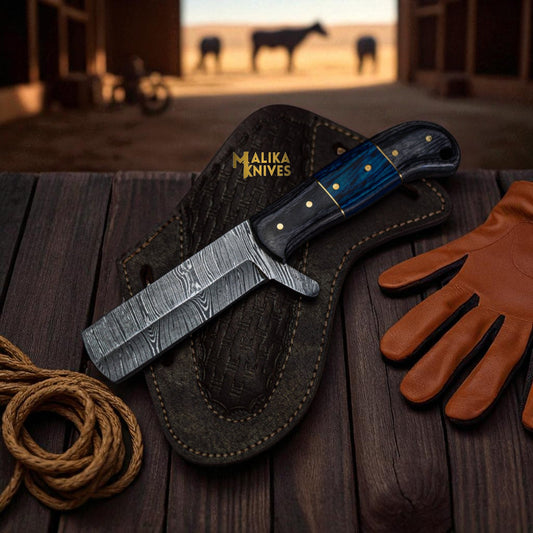
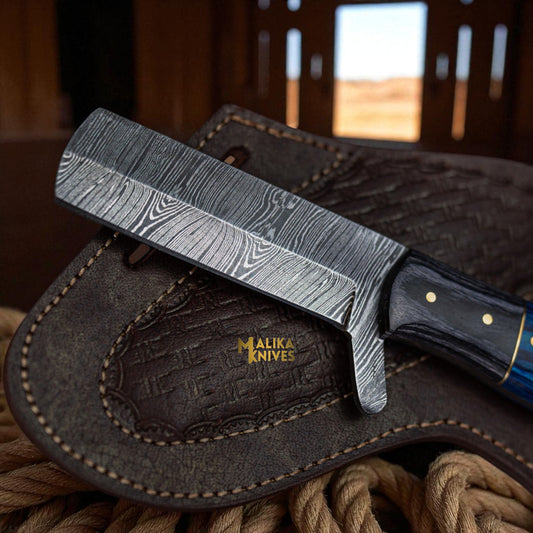
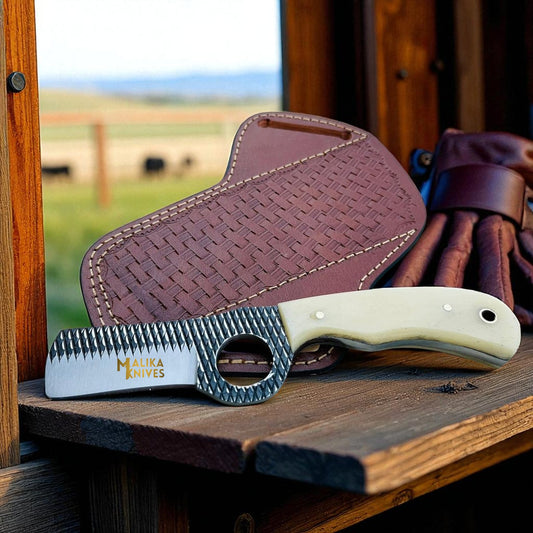
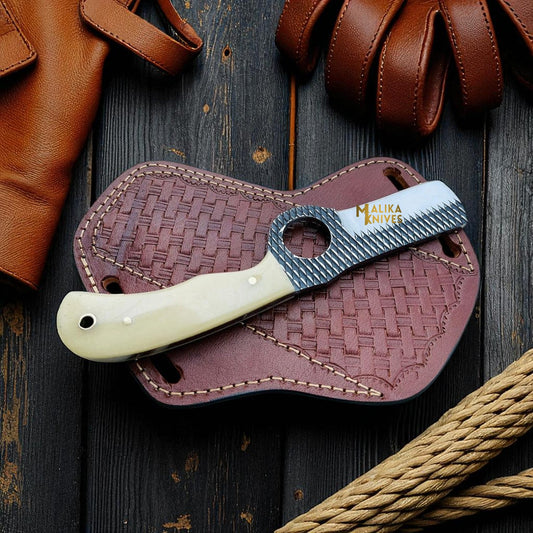
- Four steels: D2 tool steel, acid-washed D2, layered Damascus, and rasp steel reclaimed from farrier files
- Blade lengths around 4 inches on the bull cutters, up to 8 inches overall on the skinners
- Handles: pine cone resin, pakka wood, ironwood, rosewood, camel bone, cholla cactus, stabilised resin
- Fittings: brass bolsters, stainless bolsters, turquoise spacers, finger rings
- Sheaths: hand-stitched pancake and cross draw leather, cut for each blade
What is a cowboy knife?
A cowboy knife is a working fixed blade sized for ranch and stock work rather than for chopping or field dressing large game. The defining traits are a short blade, usually 3 to 5 inches, a handle shaped to stay put in a gloved or wet hand, and a leather sheath built for belt, boot or cross draw carry.
The category is defined by the job rather than by one blade shape. Ranch work means rope, baling twine, hide, leather tack, feed sacks and stock work, all of it done repeatedly through a long day. A knife for that has to be light on the belt, quick to draw, easy to control at close quarters, and easy to bring back to sharp on whatever stone is in the truck.
What a cowboy knife is not: a chopper, a survival blade or a display piece. Anyone wanting reach and chopping weight should look at the Bowie knives instead, where the blades start where they end.
Bull cutter, buckaroo or ranch knife?
Four names get used loosely across the western knife trade. They mean different things, and the difference decides which one suits your work.
|
|
Bull cutter |
Buckaroo |
Ranch knife |
Cowboy hunting knife |
|
Blade profile |
Short, deeply curved belly |
Slim clip or trailing point |
Straightforward drop point |
Drop point with more belly |
|
Blade length |
Around 4 inches |
3.5 to 5 inches |
4 to 5 inches |
4 to 5 inches |
|
Built for |
Stock work, close controlled cuts |
Everyday carry with western dress |
General chores, rope, twine, tack |
Skinning and field work on the ranch |
|
Handle emphasis |
Control, often a finger ring |
Appearance, bolsters and inlay |
Grip and durability |
Grip through a wet task |
|
Weak at |
Long slicing cuts |
Hard prying, heavy work |
Detail and skinning |
Rope and abrasive materials |
|
Browse |
The honest summary: the differences are real but narrow. A bull cutter and a buckaroo will both cut rope perfectly well. Choose on blade curve and handle feel rather than on the label, and if you are buying one knife for general ranch use, a ranch knife or a bull cutter covers the most ground.
What is a bull cutter knife used for?
A bull cutter is a compact working knife named for its original use in castrating young bulls, a job that needs a short, deeply curved blade and total control at close range. That geometry turned out to suit a great deal of other ranch work, which is why the pattern outlived its original purpose.
The curved belly does the work. A deep curve keeps more edge in contact through a drawing cut, which is what makes it efficient on rope and hide. The same curve is why it slices poorly in a straight push cut, and why it is the wrong choice for anything needing a fine point.
What is rasp steel, and why do cowboys use it?
Rasp steel is reclaimed high-carbon steel from farrier rasps, the coarse files used to shape horse hooves. A rasp is worn out for filing long before the steel is worn out for cutting, so forging one into a blade has been common practice around working stables for generations.
Three things make it worth seeking out:
- The steel is genuinely good. Farrier rasps are made from high-carbon steel hardened to survive hoof work. Reforged and heat treated properly, it takes and holds a keen edge.
- The tooth pattern survives. We leave part of the original rasp texture on the flats and the spine, so the blade carries a visible record of what it used to be. No two rasps wear the same way, so no two blades match.
- It is a genuine reclaim. The steel had a working life before it became a knife, which is a large part of why it appeals to people who actually work stock.
The trade is corrosion. Rasp steel is high carbon and not stainless, so it needs drying and a light oil after use, exactly like carbon Damascus. If you want the look with less upkeep, an acid-washed D2 blade gives a similar dark, textured finish with better weather resistance.
Which steel should you choose?
|
|
Rasp steel |
D2 tool steel |
Acid-washed D2 |
Damascus |
|
Character |
Reclaimed farrier file, visible tooth |
Clean modern working finish |
Dark, textured, low glare |
Layered pattern, forge welded |
|
Edge retention |
Good |
Excellent |
Excellent |
Very good |
|
Corrosion resistance |
Low, needs oiling |
Semi-stainless |
Semi-stainless, wash adds protection |
Low on carbon Damascus |
|
Sharpening |
Easy |
Slowest, wants a diamond plate |
Slowest |
Easy, comes back fast |
|
Best for |
Working buyers who want a real reclaim |
Hardest daily use, least sharpening |
Working looks with weather resistance |
Presentation and gifting |
For a knife that lives on a belt through a working week, D2 or acid-washed D2 asks the least of you. For a knife with a story, rasp steel. For a gift or a collection piece, Damascus.
How should a cowboy knife be carried?
Carry matters more here than on any other pattern we build, because a ranch knife is on the belt for twelve hours and gets sat on, leaned over and worked around.
-
Pancake sheath. Two belt slots either side of the blade pocket, holding the knife flat against the hip. The most stable option, and the one that stays out of the way in a saddle. Our default.
- Cross draw. Worn on the weak-hand side with the handle angled forward, drawn across the body. Easier to reach while seated or mounted, which is exactly why the style exists.
- Vertical belt. Traditional and quick to draw standing, less comfortable seated.
- Boot carry. Suits the shorter blades only, and depends on your boot.
If you spend the day mounted or in a truck seat, choose cross draw. If you are mostly on foot, a pancake sheath is more comfortable and more secure. Every knife here ships with a hand-stitched leather sheath cut for that blade, and the carry style is listed on each product page.
What are pine cone resin handles?
Around half the collection carries a pine cone handle, which is a real material rather than a printed pattern. Whole pine cones are cast into stabilised resin under pressure, the block is cured, then cut and shaped into scales. The cone structure you see is the actual cone, sectioned at whatever angle the cut fell.
Other handle materials across the collection include ironwood and rosewood for density, pakka wood for moisture stability, camel bone for a pale traditional look, and cholla cactus for an open natural structure stabilised in resin.
How do you sharpen and care for a cowboy knife?
The deep curve on a bull cutter is what most people get wrong.
- Start at the heel of the edge with the blade flat on the stone at roughly 20 degrees per side.
- Sweep the handle up steadily as you draw the knife back, so the contact point tracks around the curve at a constant angle. On a deeply curved blade the handle finishes noticeably higher than it started.
- Use fewer, slower strokes than you would on a straight edge. Rushing the sweep is what leaves a flat spot mid-belly.
- Strop on leather to remove the burr.
Rasp steel and carbon Damascus are not stainless. Wipe the blade dry after every use, including after cutting anything acidic, and apply a light film of mineral oil. Never store the knife in a damp leather sheath, because leather holds moisture against steel and will pit it. Dry the sheath separately. D2 tolerates more neglect but benefits from the same routine.
Leather sheaths last longer with an occasional wipe of leather conditioner. Avoid oil-heavy products on tooled leather, which can soften the tooling over time.
Are cowboy knives legal to own and carry?
United States
Fixed blades in this size range are legal to own throughout the United States, Canada
Fixed blades are legal to own in Canada, with prohibited classifications turning on the opening mechanism rather than blade length. Carry sheathed and for a lawful purpose.
United Kingdom and EU
Ownership is generally legal, but a fixed blade of any length is not a general-carry knife in public without a specific reason such as work or transport to and from it. Confirm current import and age-verification rules before ordering.
Who makes these knives?
Every knife here is forged and finished by hand by Naqash and Younas Minhas, with more than 15 years of combined experience at the bench. Nothing is mass-produced. Each blade is ground, heat treated and fitted individually, then paired with a hand-stitched leather sheath cut for that knife.
Because each piece is made individually, we take custom work: blade profile, steel, handle material, bolster style, finger ring, and sheath carry and tooling. Send a specification through contact and we will tell you what is achievable and what it costs.
Written by Naqash Minhas, knifemaker, Malika Knives. More about how we work.
Frequently Asked Questions
What is a cowboy knife?
A working fixed blade sized for ranch and stock work, typically 3 to 5 inches, with a handle built for grip in a gloved or wet hand and a leather sheath for belt, boot or cross draw carry. The category is defined by the job rather than by one blade shape.
What is the difference between a bull cutter and a buckaroo knife?
A bull cutter has a shorter, more deeply curved blade built for close controlled cutting. A buckaroo runs a slimmer clip or trailing point and puts more emphasis on appearance, with bolsters and inlay work. Both handle rope and general chores equally well.
Is rasp steel good for a knife?
Yes. Farrier rasps are made from high-carbon steel hardened to survive hoof work, which reforges into a good blade. Edge retention is solid and sharpening is easy. The limitation is corrosion resistance, which is lower than D2 and comparable to carbon Damascus.
What is a pine cone handle made from?
Whole pine cones cast into stabilised resin under pressure, cured, then cut and shaped into scales. The structure you see is the actual cone. Fully waterproof and dimensionally stable, available in natural, black, green and blue.
Do these knives come with a sheath?
Every knife ships with a hand-stitched leather sheath cut for that individual blade. Pancake and cross draw are both offered depending on the model, and several carry basket-tooled leather. Carry style is listed on each product page.
What is the difference between a cowboy knife and a Bowie knife?
Size and purpose. A cowboy knife runs 3 to 5 inches for close work and daily carry. A Bowie starts around 8 inches and is built for chopping and reaching. A cowboy knife handles rope and tack better, a Bowie handles firewood better.
Do these knives make a good gift?
The Damascus and pine cone builds are the usual gift choice, since the pattern and the handle both photograph well and no two are identical. For a working recipient, a D2 or acid-washed D2 blade asks less maintenance of them.
