
A ranch knife is the plain working blade of the three cowboy patterns: no bolsters, no inlay, nothing on it that is not doing a job. Four inches of blade on an eight inch overall, a handle that grips through a glove, and a leather sheath cut for belt or pancake carry. Forged in reclaimed farrier's rasp, D2 and Damascus at 59 to 61 HRC. If you want the dressed version, that is a buckaroo.
-
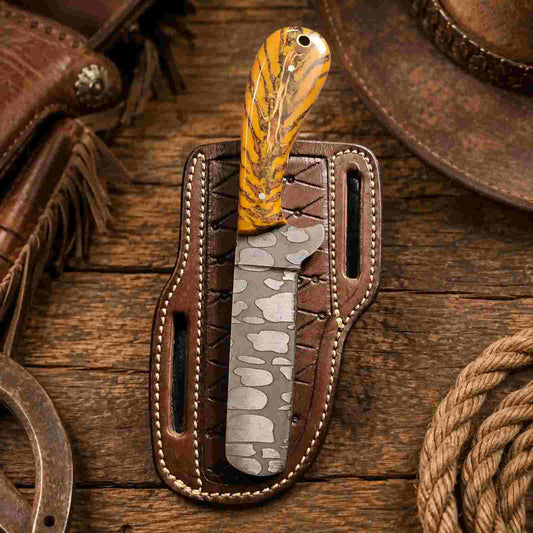
Custom Handmade Damascus Steel Bull Cutter Knife with Leather Sheath
Regular price $119.99 USDRegular priceUnit price per$240.00 USDSale price $119.99 USDSale -
Handcrafted Fixed Blade Bull Cutter Knife with Wood and Resin Handle | Leather Sheath
Regular price $125.00 USDRegular priceUnit price per$250.00 USDSale price $125.00 USDSale -
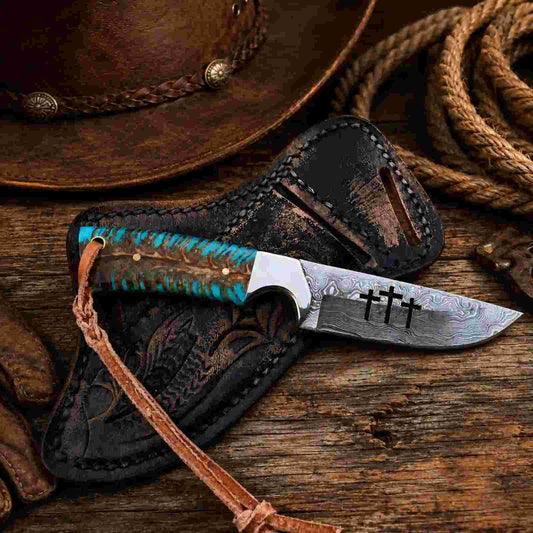
Handmade Damascus Bull Cutter with Blue Resin & Natural Wood Handle
Regular price $115.00 USDRegular priceUnit price per$230.00 USDSale price $115.00 USDSale -
5-Inch Western Bull Cutter Knife with Red Turquoise Pine Cone Handle & Blue Leather Sheath
Regular price $110.00 USDRegular priceUnit price per -
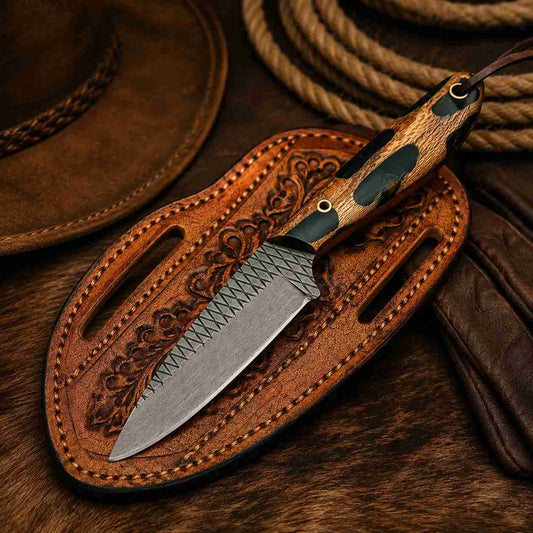
4-Inch Rasp File Steel Knife with Cross Wirecut Blade, Rosewood Handle & Leather Sheath
Regular price $125.00 USDRegular priceUnit price per$250.00 USDSale price $125.00 USDSale -
3.5-Inch D2 Steel Cowboy Knife with Texas Enforcement Resin Handle & Steel Bolster
Regular price $130.00 USDRegular priceUnit price per$260.00 USDSale price $130.00 USDSale -
Handmade Cowboy Knife with Rasp Steel Blade, Resin & Wood Handle, Steel Bolster
Regular price $120.00 USDRegular priceUnit price per$240.00 USDSale price $120.00 USDSale -
Rasp Steel Bullcutter Knife with Black Pine Cone Handle
Regular price $120.00 USDRegular priceUnit price per$240.00 USDSale price $120.00 USDSale -
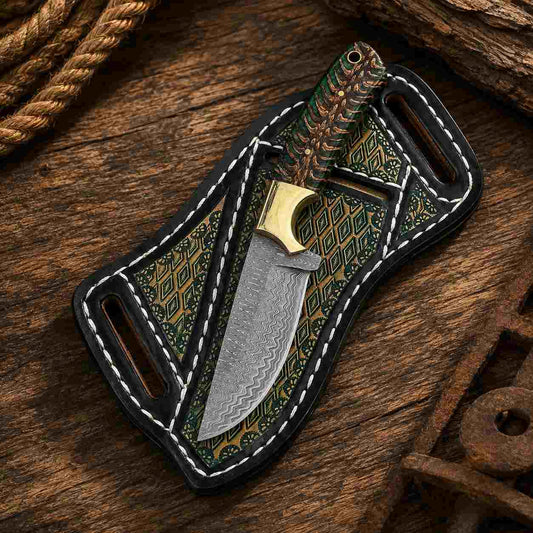
Green Pine Cone Damascus Steel Buckaroo Knife
Regular price $130.00 USDRegular priceUnit price per$260.00 USDSale price $130.00 USDSale -

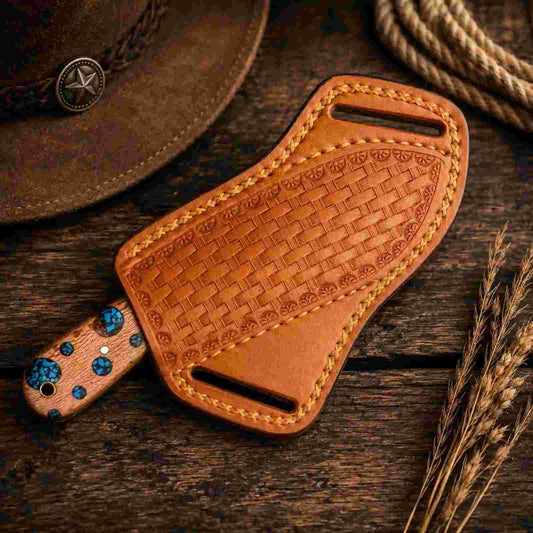
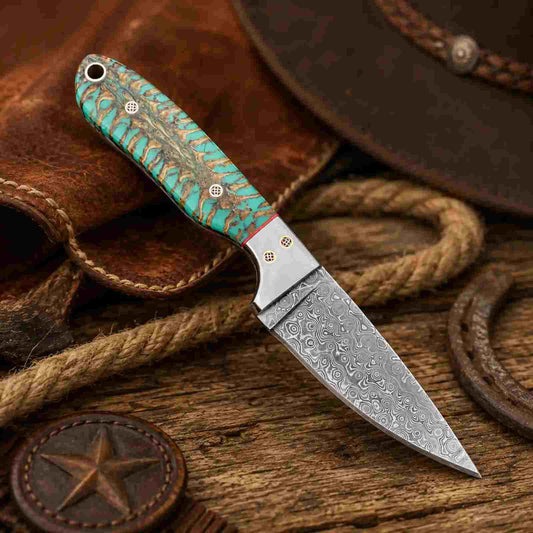
Cholla Cactus Buckaroo Knife – Damascus Steel Blade with Natural Cactus Handle & Leather Sheath
Regular price $125.00 USDRegular priceUnit price per$250.00 USDSale price $125.00 USDSale -
Praying Cowboy Knife – Damascus Steel Blade with Pine Cone Handle & Leather Sheath
Regular price $120.00 USDRegular priceUnit price per$240.00 USDSale price $120.00 USDSale -
Bullcutter Knife – Acid Wash D2 Steel Blade with Pine Cone Handle & Leather Sheath
Regular price $110.00 USDRegular priceUnit price per$220.00 USDSale price $110.00 USDSale -
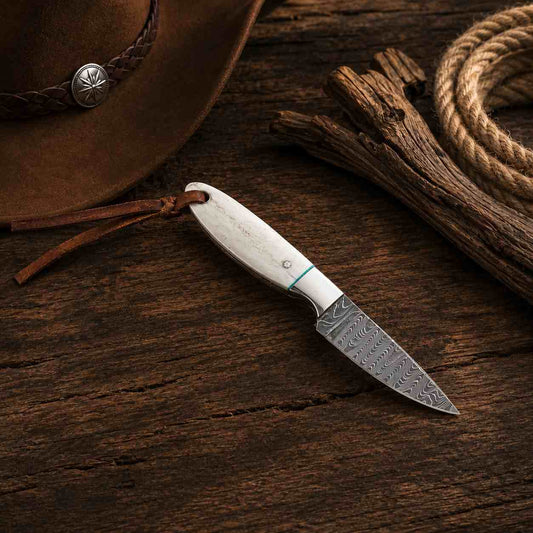
Buckaroo Damascus Steel Knife – Western Fixed Blade with Camel Bone Handle
Regular price $105.00 USDRegular priceUnit price per$210.00 USDSale price $105.00 USDSale -
Damascus Buckaroo Knife with Pine Cone Handle & SS Masonic Bolster
Regular price $140.00 USDRegular priceUnit price per$280.00 USDSale price $140.00 USDSale -
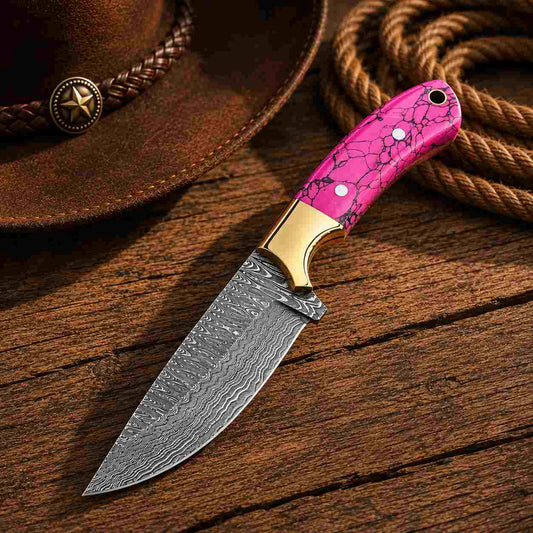
Turquoise Buckaroo Damascus Knife with Brass Bolster
Regular price $130.00 USDRegular priceUnit price per$260.00 USDSale price $130.00 USDSale -
Rasp Steel Cowboy Knife with Pine Cone Handle & Leather Sheath
Regular price $120.00 USDRegular priceUnit price per$240.00 USDSale price $120.00 USDSale

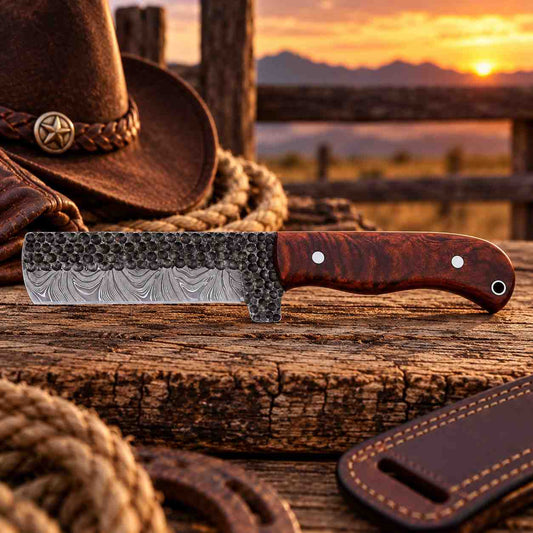


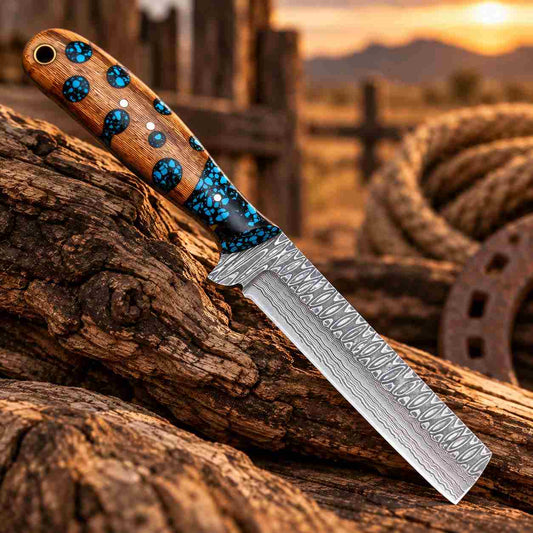


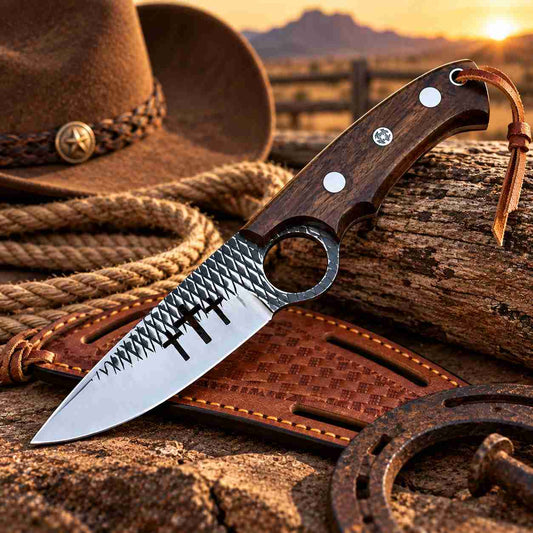











Quick facts:
- Ranch knives are the plainest and lowest-priced of our cowboy patterns
- Steels: reclaimed farrier's rasp, D2 tool steel, acid-washed D2, and Damascus, all at 59 to 61 HRC
- Around 4 inches of blade on an 8 inch overall length
- Handles: pine cone resin, ironwood, rosewood, ashwood, stag horn, pakka wood, stabilised resin
- Leather sheath with every knife, pancake or crossdraw
- Full tang construction, no moving parts to fail or maintain
What is a ranch knife?
A ranch knife is a plain working fixed blade sized for the jobs that come up on a working property every day. Around four inches of blade, a full-length handle, a leather sheath, and no decoration. The whole point of the pattern is that nothing on it is there to be looked at.
Where it fits against the other two cowboy patterns: a buckaroo is the dressed version with a longer handle for mounted work, and a bull cutter has a deeper curve built for close stock work. A ranch knife is the one you buy first and replace last.
What does a ranch knife actually get used for?
The daily list is unglamorous and that is the point:
- Baling twine, hay strings and poly rope
- Feed sacks, mineral bags and bulk packaging
- Leather tack, latigo, saddle strings and repairs
- Hose, tubing and zip ties around water lines and equipment
- Light food preparation at camp or in the truck
- Opening and trimming almost anything, several times a day
What it does badly: chopping, batoning, prying, and fine cape work. For chopping reach see the western Bowie knives. For field dressing and caping see the skinning knives and gut hook knives.
The most common buying mistake on this pattern is going bigger. A six inch blade feels more capable in the hand and is worse at every job on the list above, because ranch work is close work.
Which steel should you choose?
Four steels run through the collection, all heat treated to 59 to 61 HRC, which is the range that holds a working edge and still comes back on an ordinary stone in the field.
|
Rasp steel |
D2 tool steel |
Acid-washed D2 |
Damascus |
|
|
Origin |
Reclaimed farrier file |
Single tool steel |
D2 with a dark chemical finish |
Folded and forge-welded, etched |
|
Look |
File teeth along the spine |
Clean working finish |
Dark, textured, low glare |
Layered pattern, no two alike |
|
Edge retention |
Good |
Excellent |
Excellent |
Very good |
|
Corrosion resistance |
Low, will patina |
Semi-stainless |
Semi-stainless, wash helps |
Low on carbon Damascus |
|
Sharpening |
Easy |
Slowest, wants a diamond plate |
Slowest |
Easy |
|
Best for |
A knife with a working history |
Hardest use, least sharpening |
Working looks, better weather |
A knife that gets looked at |
For a knife that lives on a belt through a working week and gets sharpened rarely, D2 asks the least of you. For a knife you touch up often and want to come back fast, rasp steel or Damascus. Rasp steel is the one people keep, because reclaimed farrier file carries a history the others do not.
Which ranch knife is right for you?
- One knife, lowest price, hardest use. A plain rasp steel build with a wood handle. Nothing to baby, easy to sharpen on whatever stone is in the truck.
- You sharpen once a season. A D2 or acid-washed D2 blade. Best edge retention here, and the acid wash cuts glare and hides working marks.
- You want grip in wet weather. Ironwood or rosewood over polished resin or bone. Textured wood holds better in a wet or gloved hand.
- You work mounted or from a truck seat. Order it with a crossdraw sheath, or look at the buckaroo knives, which are cut for it as standard.
- It is a gift for someone who works. A Damascus blade with a plain wood handle gives the pattern without making it a knife they are afraid to use.
Caught between two? Send us both through contact and we will tell you which one we would keep.
Pancake or crossdraw?
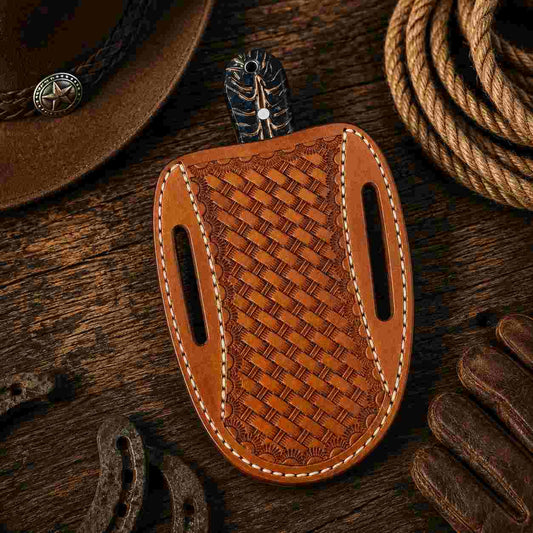
A pancake sheath has belt slots either side of the blade pocket, which holds the knife flat against the hip and spreads the weight across the belt rather than hanging it off one loop. It is the more comfortable option on foot and through a long day, and it is our default.
A crossdraw sheath rides on the weak-hand side with the handle angled forward, so it can be seated or mounted without twisting for it. If you spend the day on a horse or in a truck seat, take crossdraw.
Vertical belt carry is traditional and quickest to draw standing, and least comfortable seated. Our cowboy knife sheath guide covers all three and when each one earns its place.
Handle materials
- Ironwood and rosewood. Dense, close-grained, and the best grip of anything here in a wet or gloved hand. The working choice.
- Ashwood. Lighter and cleaner-looking, comfortable over long carry.
- Pine cone resin. Whole pine cones cast into stabilised resin, cured, then cut into scales. Fully waterproof and dimensionally stable, with moderate grip when wet.
- Stag horn and antler. Natural texture, traditional western appearance, no two alike.
- Pakka wood. Wood laminate stabilised in resin, so it holds a finish and shrugs off moisture better than natural hardwood.
How do you sharpen and care for one?
At 59 to 61 HRC every blade here comes back on an ordinary stone, which is the point of that hardness on a working knife.
- Work the straight section flat on the stone at roughly 20 degrees per side.
- Lift the handle gradually as the contact point reaches the belly, so the stone tracks the curve at a constant angle. Lifting too late leaves a dull patch just ahead of the belly, which is the most common fault on this shape.
- Finish the tip with lighter pressure.
- Strop on leather to take off the burr.
D2 resists abrasion by design, so it wants a diamond plate rather than a soft stone. Rasp steel and Damascus come back on almost anything.
Rasp steel and carbon Damascus are not stainless. Wipe the blade dry after use, including after anything acidic, and put a light coat of mineral oil or paste wax on before storage. Keep the knife out of the sheath for long-term storage, because tanned leather holds moisture against steel and will pit it.
Are ranch knives legal to own and carry?
United States
A four inch fixed blade is legal to own throughout the United States and sits below the length thresholds most states apply to larger knives. Carry rules are still set at state and often municipal level, so check your local ordinance, particularly for concealed carry.
Canada
Fixed blades are legal to own in Canada, where prohibited classifications turn on the opening mechanism rather than blade length. Carry sheathed and for a lawful purpose.
United Kingdom and EU
Ownership is generally legal, but a fixed blade of any length is not a general-carry knife in public without a specific reason such as work or transport to and from it. Confirm current import and age-verification rules before ordering.
Rules change. Treat this as a starting point and verify current law where you live.
Who makes these knives?
Every blade here is forged and finished by hand by Naqash and Younas Minhas, with more than 15 years of combined experience at the bench. Nothing is mass-produced. Each knife is ground, heat treated and fitted individually, then paired with a leather sheath cut and stitched for that blade.
Custom work is available on blade proportion, steel, handle material and sheath pattern. Send a specification through contact and we will tell you what is achievable and what it costs.
Written by Naqash Minhas, knifemaker, Malika Knives. More about how we work.
Frequently asked questions
What is a ranch knife?
A plain working fixed blade sized for daily chores on a working property, around four inches of blade on an eight inch overall, with a full-length handle and a leather sheath. The defining trait is the absence of decoration: nothing on it is there that is not doing a job.
What is the difference between a ranch knife and a buckaroo knife?
Dress and proportion. A buckaroo has a longer handle sized for a gloved rein hand, bolsters and often inlay work, and a sheath cut for mounted carry. A ranch knife is the plain version at a lower price. Both cut the same.
What is the difference between a ranch knife and a bull cutter?
Blade curve. A bull cutter has a deeper belly built for close controlled stock work, which makes it efficient on rope and hide and poor at straight push cuts. A ranch knife runs a moderate belly and handles a wider range of chores.
What blade length should a ranch knife be?
Around four inches. Ranch work is close work, and a longer blade feels more capable while being worse at every job on the list. Anything past five inches starts getting in the way on a belt through a full day.
What steel is best for a ranch knife?
D2 for the hardest use with the least sharpening. Rasp steel for a working knife with a real history and easy field sharpening. Damascus for a knife that will be looked at. All are heat treated to 59 to 61 HRC.
What does 59 to 61 HRC mean in practice?
The Rockwell C figure measures blade hardness. At 59 to 61 HRC a blade holds a working edge through extended cutting and still comes back on a pocket stone without specialist equipment, which is what matters when sharpening happens in the field rather than at a bench.
Are these knives full tang?
Yes. The steel runs the full length of the handle with the scales pinned either side. Full tang and no moving parts is most of why a fixed blade outlasts a folder on a working property.
Do they come with a sheath?
Every knife ships with a handmade leather sheath cut for that individual blade. Pancake and crossdraw are both available depending on the model, and the carry style is listed on each product page.
Can a ranch knife be used for hunting?
For skinning and general field work, yes. For field dressing and caping, a dedicated skinning knife or gut hook does the job better. A ranch knife is built first for chores rather than for game.
