
Hand-forged Damascus folding knives, built one at a time for pocket carry and everyday use. Camel bone, ram horn and engraved wood handles, with hand engraving available on the blade and bolsters. A folder is a different engineering problem from a fixed blade: the lock, the pivot and the spring all have to be fitted by hand, and each one takes longer than a knife of the same size that does not fold. Four in stock, from $80.
-
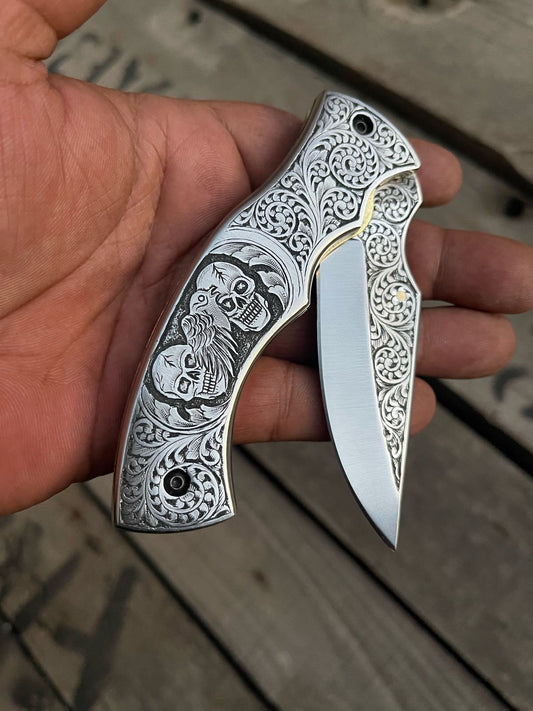
Hand Engraved D2 Steel Folding Knife With Leather Sheath | Liner Lock Pocket Knife
Regular price $390.00 USDRegular priceUnit price per$500.00 USDSale price $390.00 USDSale -
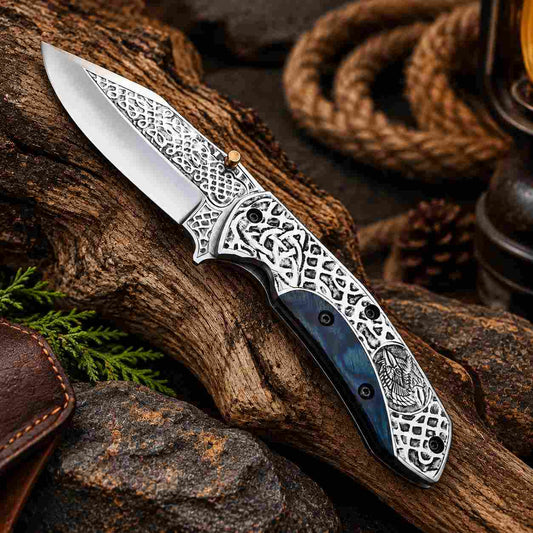
Acid Etched Viking Folding Knife With D2 Steel Blade and Leather Sheath
Regular price $145.00 USDRegular priceUnit price per$290.00 USDSale price $145.00 USDSale -
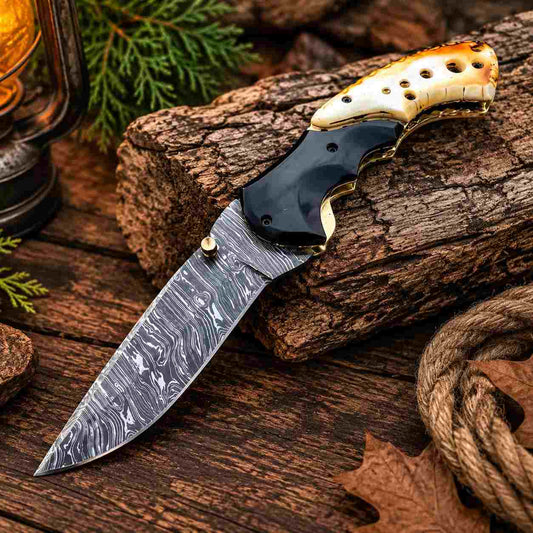
Hand Forged Damascus Folding Knife With Bull Horn Handle & Leather Sheath
Regular price $149.00 USDRegular priceUnit price per -
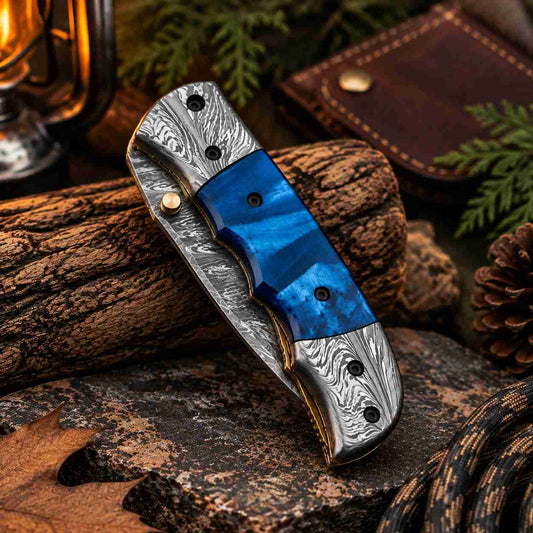
Feather Pattern Damascus Folding Knife With Blue Pearl Resin Handle & Sheath
Regular price $250.00 USDRegular priceUnit price per$500.00 USDSale price $250.00 USDSale -
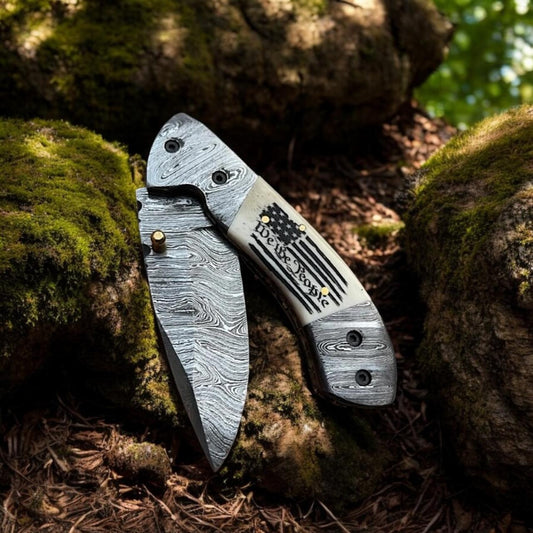
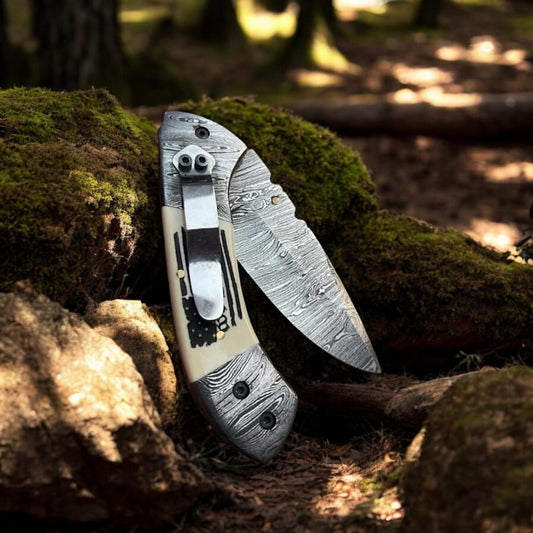
Damascus Folding Knife with Camel Bone Handle | Hand-Engraved People’s Flag | EDC Knife with Gift Box
Regular price From $160.00 USDRegular priceUnit price per$250.00 USDSale price From $160.00 USDSale -
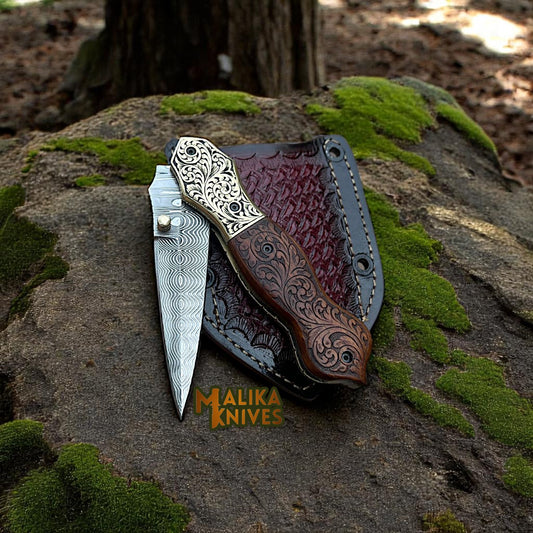
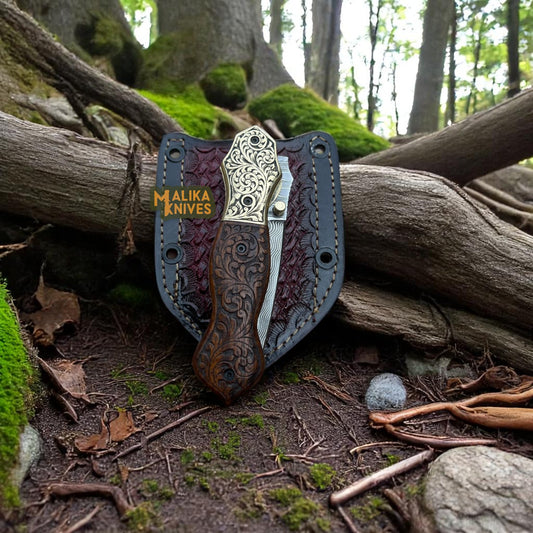
Hand-Engraved Damascus Steel Folding Knife – Custom EDC with Engraved Wood Handle-8010
Regular price $255.00 USDRegular priceUnit price per$350.00 USDSale price $255.00 USDSale -
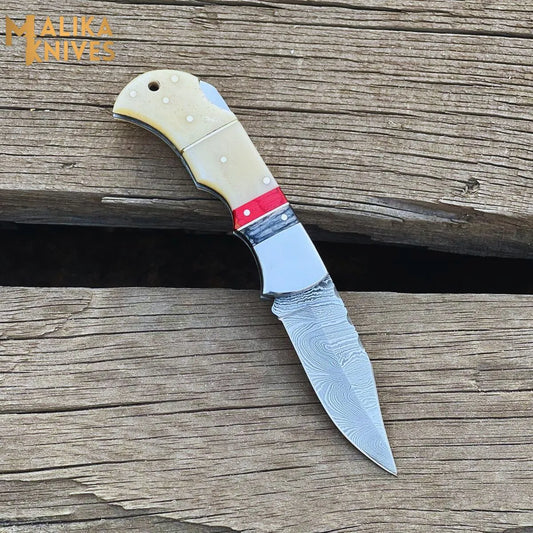
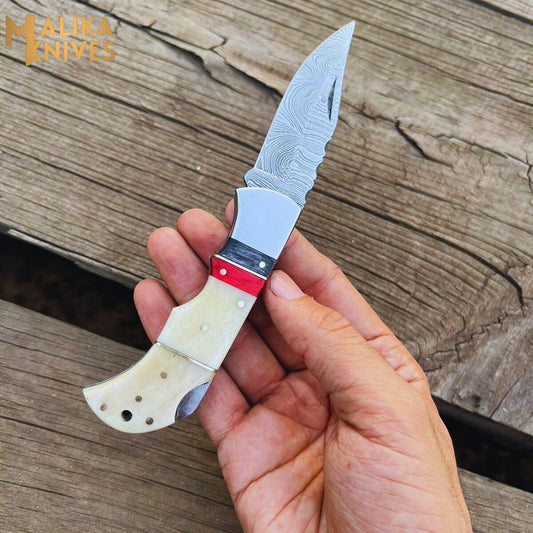
Custom Handmade Thumb Lock (Back Lock) Folding Knife with Camel Bone handle-0802
Regular price $80.00 USDRegular priceUnit price per$160.00 USDSale price $80.00 USDSale -
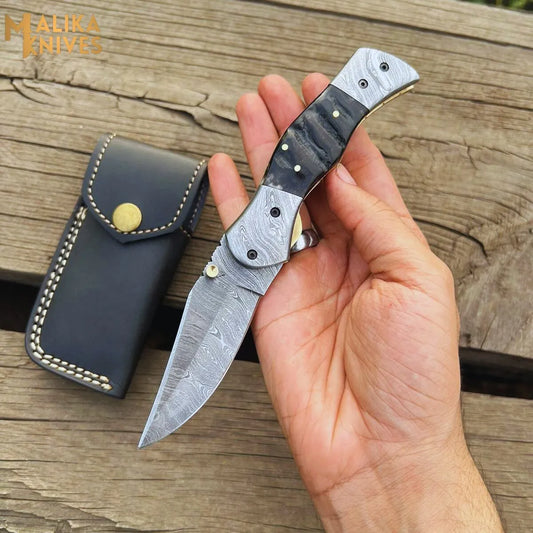
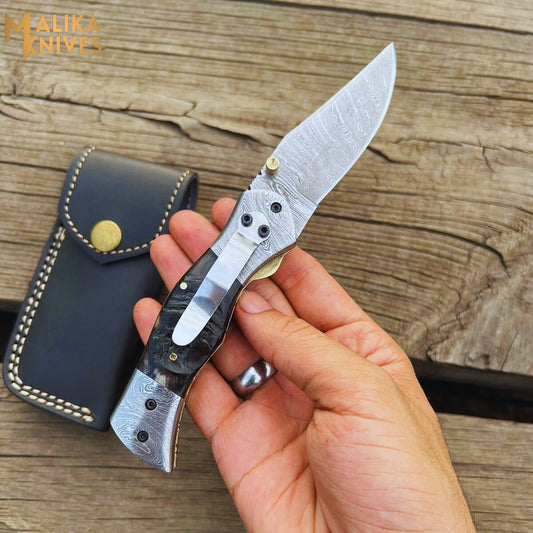
Custom Handmade Folding knife with Ram horn handle-0803
Regular price $113.00 USDRegular priceUnit price per$130.00 USDSale price $113.00 USDSale




Quick facts:
- Hand-forged Damascus blades,
- Lock types: back lock confirmed on one build,
- Handles: camel bone, ram horn, engraved hardwood
- Hand engraving available on blade, bolsters and handle
- Gift box or leather sheath included depending on the model
- Locking folders are treated as fixed blades under UK carry law. See the legality section
Who makes these knives?
Every blade is forged and finished by hand by us, Naqash and Younas Minhas, with more than 15 years of combined experience at the bench. We pattern-weld the Damascus billets ourselves, then forge, grind, heat treat and fit each knife individually.
A folder is harder to build than a fixed blade of the same size, and worth understanding if you are comparing prices. A fixed blade is a tang, two scales and some pins. A folder needs a pivot that turns smoothly without play, a lock that engages every time and releases cleanly, a backspring tensioned so the blade neither flops nor fights you, and bolsters and liners fitted to tolerances a fixed blade never asks for. Get any one of those wrong and the knife feels cheap in the hand regardless of how good the blade is.
Hand engraving is available on the blade, bolsters and handle, and two of the knives here carry it already.
Lock types, and why the lock is the most important spec on a folder
On a fixed blade the steel is the headline. On a folder the lock is, because it is the part that decides whether the knife is safe and whether it is legal to carry where you live.
|
Lock |
How it works |
Strength |
Closes with |
Notes |
|
Back lock |
A spring-loaded bar on the spine drops into a notch in the blade tang |
Strong, very secure |
Press the bar on the spine |
Ambidextrous, traditional, the type fitted on our thumb lock model |
|
Liner lock |
A sprung leaf inside the handle springs behind the tang |
Strong |
Push the liner aside with a thumb |
One-handed, usually right-hand biased |
|
Frame lock |
The handle slab itself acts as the lock bar |
Strongest of the common types |
Push the frame aside |
Heavier, modern |
|
Slip joint |
A backspring holds the blade open by tension only, no lock |
Not a lock at all |
Fold it shut against spring pressure |
The traditional pocket knife pattern, and the one UK carry law permits |
Why this matters beyond safety. A back lock, liner lock and frame lock all lock the blade open. A slip joint does not. In the United Kingdom, that single distinction decides whether a knife can be carried in public without needing to justify it, and the rule catches almost everyone by surprise. See the legality section below.
What to check in the hand. Open and close it ten times. The lock should engage with an audible, positive click every time, the blade should have no side-to-side play once locked, and the release should need deliberate pressure rather than a brush. A lock that engages nine times out of ten is a lock that will fail on the tenth.
Which folding knife is right for you?
- Cheapest way in, and the most traditional. The back lock folder with a camel bone handle at $80. A back lock is ambidextrous and the most proven mechanism here.
- Natural handle material with character. The ram horn folder. No two pieces of horn are alike, and it ages in the pocket.
- The most work in the collection. The hand-engraved Damascus folder with an engraved wood handle, which comes with a custom leather sheath rather than a box.
- A gift. The Damascus folder with a camel bone handle and hand engraving, supplied in a gift box. Options are selectable on the product page.
- Something specific. Custom folders are available: blade length, lock type, handle material, bolster style, engraving. Send us a specification through contact.
Caught between two? Send us both and we will tell you which one we would keep.
What steel, and how hard?
Our Damascus is forge-welded from two carbon steels, folded to build hundreds of layers, then etched so the pattern shows. One steel carries the edge, the other resists the etch and appears bright against it.
What carbon Damascus means for a pocket knife specifically. A folder lives against your body, and a pocket is a warm, humid place. Carbon Damascus has no chromium film protecting it, so a blade carried daily in a pocket will develop a patina faster than the same steel on a knife kept in a drawer. A grey-brown patina is normal, stable, and actually slows further corrosion. Orange rust sitting proud of the surface is the one to act on.
Two practical consequences. Wipe the blade dry before it goes back in your pocket after cutting anything wet or acidic, and give the pivot a drop of oil every few months, because a dry pivot is what makes a folder feel gritty.
On layer count. Layering is aesthetic, and historically a way of managing impurities in less refined steel. A blade's performance comes from the steels chosen and the heat treatment. Anyone selling on layer count alone is selling appearance, which is a fine reason to buy a folder with a pattern like this, as long as it is named as one.
Handle materials
- Camel bone. Pale, dense, takes a fine polish, and the traditional pocket knife material. Fitted on two of the four.
- Ram horn. Natural texture and colour variation, so no two are alike. Warms in the hand and darkens over years of carry.
- Engraved hardwood. Where the engraving is the point. Carries the pattern work on the handle as well as the blade.
The honest note for pocket carry. Polished bone and horn are slicker than a textured synthetic, and a folder gets opened with one hand more often than a fixed blade does. If you want maximum grip security you want micarta or G10, which we can fit on a custom build but do not currently stock on a folder. For a pocket knife used for ordinary cutting, bone and horn are perfectly secure and considerably better looking.
Natural materials also move slightly with humidity over years. A tiny amount of movement between scale and liner on a decades-old bone-handled folder is normal rather than a fault.
Care and sharpening
A folder needs two things a fixed blade does not: pivot maintenance and lint management.
- Oil the pivot every few months. One drop, worked in by opening and closing. A dry pivot is the most common reason a good folder starts feeling rough.
- Clear the handle cavity. Pocket lint packs into the channel behind the blade and holds moisture against the steel. Compressed air or a toothpick, every month or so if you carry it daily.
- Wipe the blade dry before closing it. Closing a wet blade traps water inside the handle, which is the worst place for it.
- Never the dishwasher, and do not soak a folder. Water gets into the pivot and the handle and does not come out.
Sharpening. Work at roughly 15 to 20 degrees per side, coarse to fine on a whetstone, then a few light passes on leather to remove the burr. A pocket knife does lighter work than a hunting blade, so 15 degrees gives a keener edge that holds up fine. Carbon Damascus comes back easily and does not need diamond plates.
Full routine in our Damascus care guide, and technique in the sharpening guide, with the angle adjusted as above.
Are folding knives legal to carry?
Read this before ordering if you are outside North America, because folders are the one category where the law turns on a detail most buyers do not think about.
United Kingdom. Under section 139 of the Criminal Justice Act 1988, carrying any bladed or pointed article in a public place without good reason is an offence. One narrow exception exists: a folding pocketknife with a cutting edge of 3 inches or less. But the courts have held, in Harris v DPP and confirmed in R v Deegan, that "folding" means the blade must be foldable at all times without pressing a button or releasing a catch. A knife that locks open does not qualify, regardless of how short the blade is, and sits in the same legal category as a fixed blade. If a folder locks, you need a good reason to carry it.
So a locking folder from this collection is legal to own in the UK and legal to carry only with good reason, such as work use. The only knife carryable without justification there is a non-locking slip joint under 3 inches, which we can build to order if that is what you need.
United States. Folding knives are legal to own throughout. Carry rules are set at state and often municipal level, and some jurisdictions restrict blade length or particular opening mechanisms. Automatic and switchblade rules vary considerably by state. Check your state statute and your city ordinance.
Canada. Folding knives are legal to own. Prohibited classifications turn on mechanism rather than blade length: knives that open automatically by gravity, centrifugal force or a button are prohibited weapons. A manually opened folder with a conventional lock is not. Carrying in public requires a lawful purpose.
EU and elsewhere. Rules vary widely, and several countries restrict one-handed opening or locking mechanisms specifically. Import rules and age verification differ too.
Rules change and none of this is legal advice. Verify the position where you live, and contact us before ordering if you want us to confirm what we can ship to your country or whether a non-locking build would suit you better.
Frequently asked questions
What lock do these folding knives use?
One is a back lock, where a spring-loaded bar on the spine drops into a notch in the blade tang and releases by pressing the spine. Back locks are ambidextrous and among the most proven mechanisms. Lock type for the other models is listed on each product page.
Is a back lock or a liner lock better?
Neither is better, they suit different habits. A back lock is ambidextrous and very secure but needs two hands to close comfortably. A liner lock closes one-handed but is usually biased toward right-hand use. A frame lock is the strongest of the common types and the heaviest.
Do you make non-locking slip joint folders?
Not as stock, but yes to order. A slip joint holds the blade open on backspring tension rather than a lock, which is the traditional pocket knife pattern and the one UK carry law permits. Tell us through contact if that is what you need.
Will a Damascus folder rust in my pocket?
It will patina, and it will rust only if you leave it wet. A pocket is warm and humid, so a carried blade develops a patina faster than one kept in a drawer. Wipe the blade dry before closing it, especially after anything wet or acidic, and the patina stays grey rather than turning to rust.
How do I keep a folder feeling smooth?
A drop of oil on the pivot every few months, worked in by opening and closing, and clear the handle cavity of pocket lint with compressed air or a toothpick. A gritty folder is almost always a dry pivot or packed lint rather than a worn pivot.
Can a folding knife be sharpened normally?
Yes. Work at roughly 15 to 20 degrees per side on a whetstone, coarse to fine, then strop. A pocket knife does lighter work than a field knife, so a keener angle holds up fine. Keep the pivot dry while you work and oil it afterwards.
Can I get a folding knife engraved?
Yes. Hand engraving is available on the blade, the bolsters and the handle, and two of the four knives here carry it already. For a name, date or logo, contact us first so we can confirm the layout fits the panel.
What does the knife come with?
Depends on the model. One ships in a gift box and one with a custom leather sheath. Check the product page for the specific knife.
Can I order a custom folder?
Yes. Blade length and profile, lock type including non-locking slip joint, handle material, bolster style, engraving and what it ships in are all specifiable. Send us what you have in mind and we will tell you what is achievable and what it costs.
