
Hand-forged kitchen knives in layered Damascus, sold as matched sets with a leather roll or case. Chef, santoku, slicer, cleaver, utility, bread and paring blades, forged and fitted individually rather than stamped from sheet. One thing to know before you buy: these are carbon steel, so they need hand washing and drying and they will patina. If you want a knife you can leave in the sink, buy stainless from someone else. We would rather say so.
-
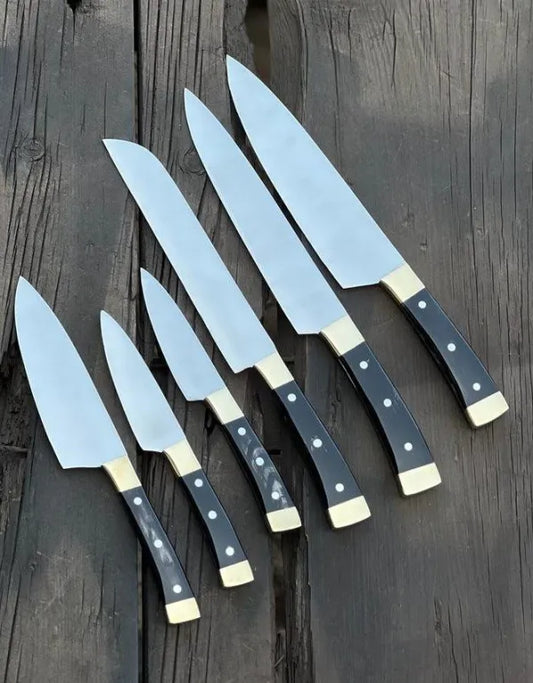
Malika Ultimate Kitchen Knife Set: Premium Black & white Collection with Custom Leather Carrying Case -0205
Regular price $230.00 USDRegular priceUnit price per$460.00 USDSale price $230.00 USDSale -
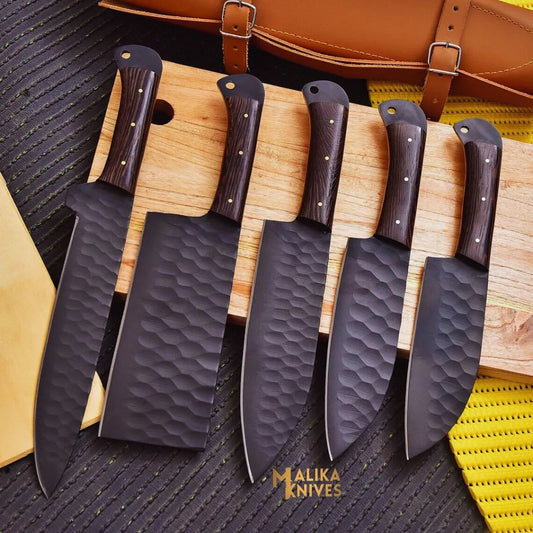
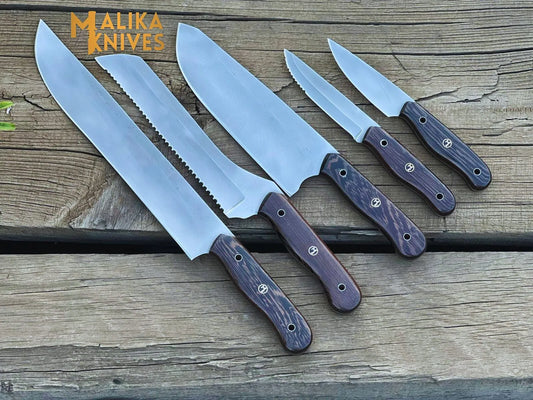
5 Piece Hammer Forged Kitchen Knife Set With Rosewood Handle
Regular price $290.00 USDRegular priceUnit price per$490.00 USDSale price $290.00 USDSale -
EDC kitchen knife set for home chefs-0210
Regular price $190.00 USDRegular priceUnit price per$380.00 USDSale price $190.00 USDSale -
High-quality Damascus kitchen knife set for versatile use-0209
Regular price $179.00 USDRegular priceUnit price per$350.00 USDSale price $179.00 USDSale -
Affordable kitchen knife set with exceptional performance-0208
Regular price $220.00 USDRegular priceUnit price per$370.00 USDSale price $220.00 USDSale -
Unleash Your Inner Chef with Our Top-Notch Chef Knives Set-0207
Regular price $230.00 USDRegular priceUnit price per$390.00 USDSale price $230.00 USDSale -
Professional Chef knife Set with Leather Case-0203
Regular price $250.00 USDRegular priceUnit price per$350.00 USDSale price $250.00 USDSale -
Malika Ultimate Kitchen Knife Set: Premium All-in-One Collection with Custom Leather Carrying Case - Perfect for Home Chefs & Culinary Enthusiasts-0204
Regular price $230.00 USDRegular priceUnit price per$275.00 USDSale price $230.00 USDSale -
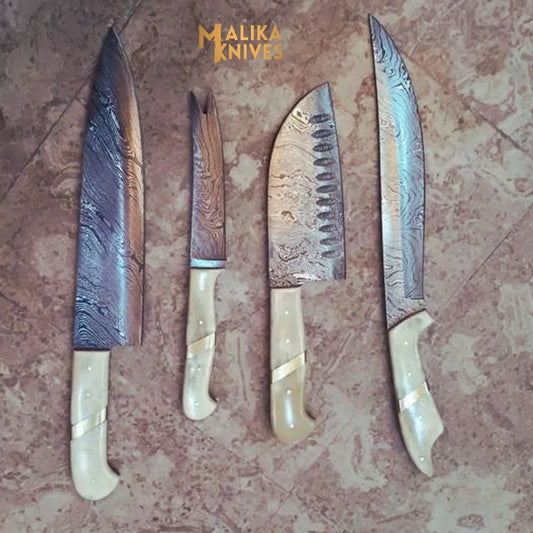
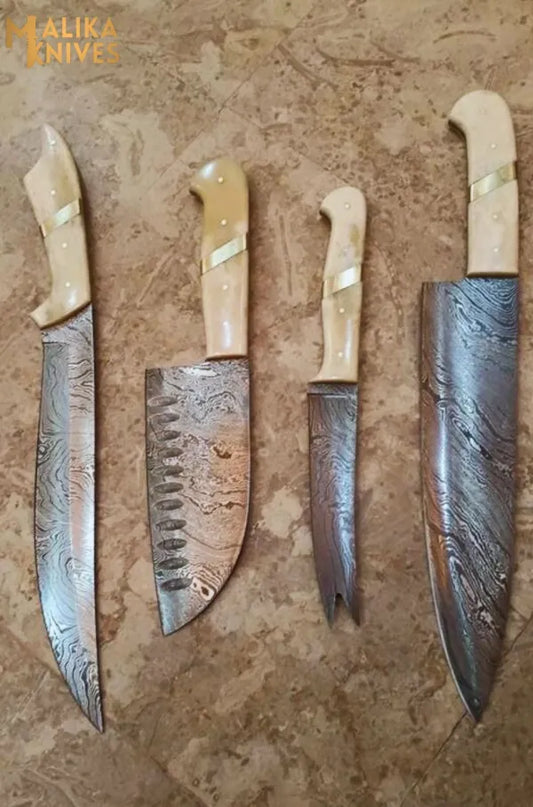
Handmade Camel Bone Chef knives Set with Leather Case-0206
Regular price $250.00 USDRegular priceUnit price per$500.00 USDSale price $250.00 USDSale -
Unleash Your Inner Chef with Our Top-Notch Chef Knives Set-0202
Regular price $230.00 USDRegular priceUnit price per$460.00 USDSale price $230.00 USDSale -
Top-rated kitchen knife set for home chefs-0201
Regular price $290.00 USDRegular priceUnit price per$400.00 USDSale price $290.00 USDSale
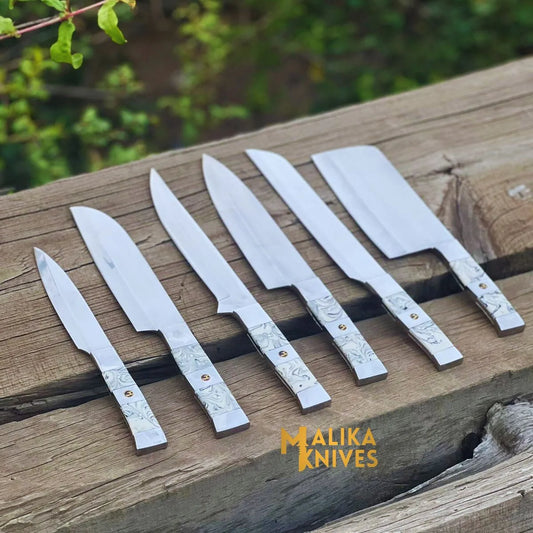
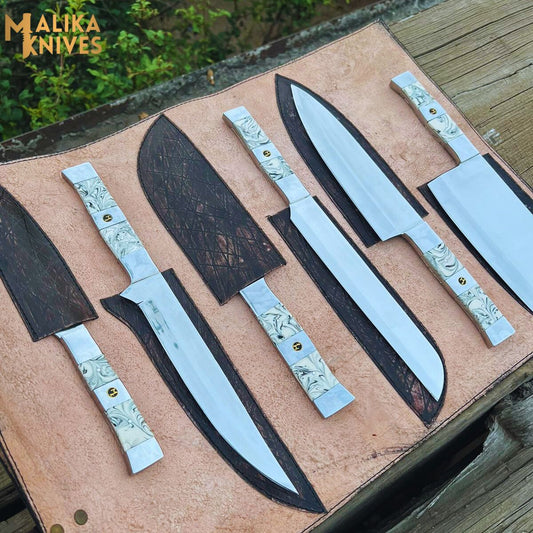

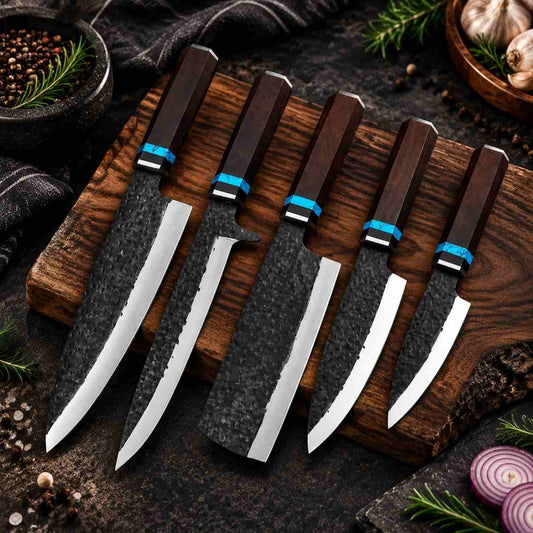
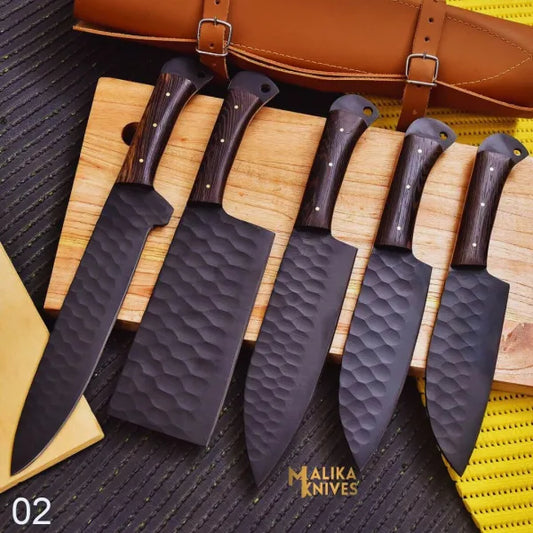

Quick facts:
- Hand-forged layered Damascus, 1095 and 15N20
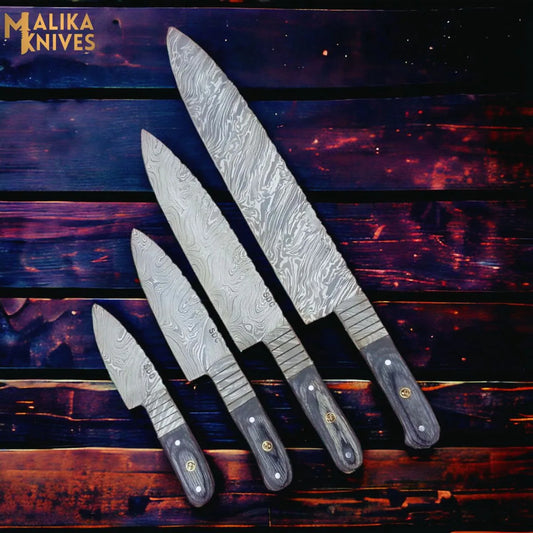
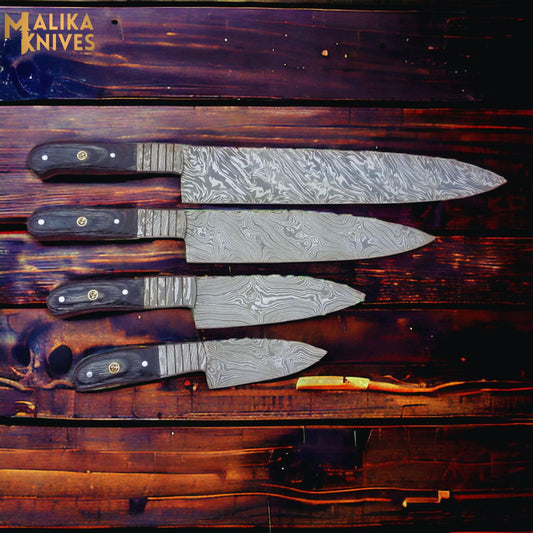
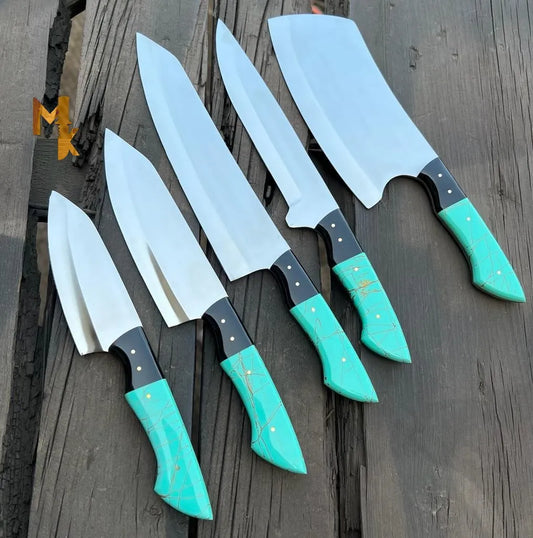
- Sets of 4 and 5 pieces, covering chef, santoku, slicer, carving, cleaver, utility, bread and paring
- Full tang construction with brass or stainless bolsters
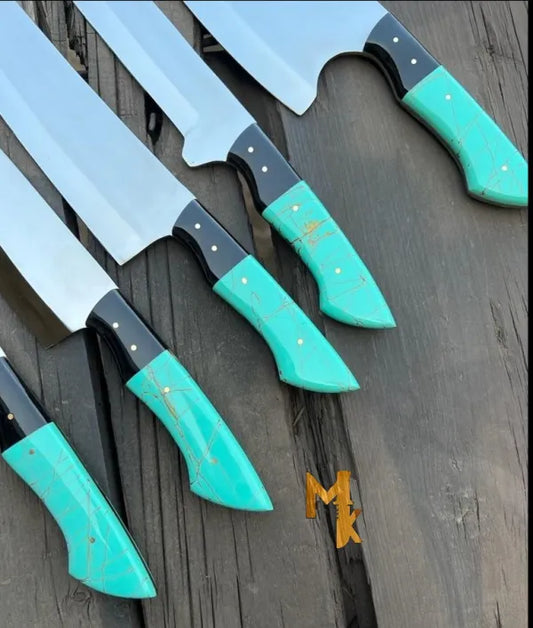
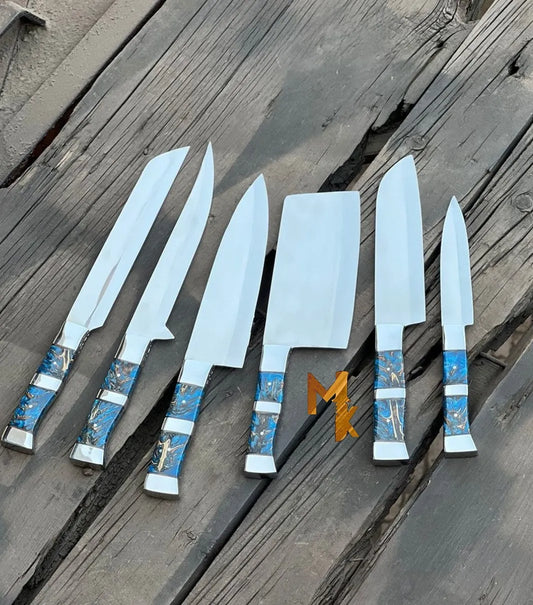
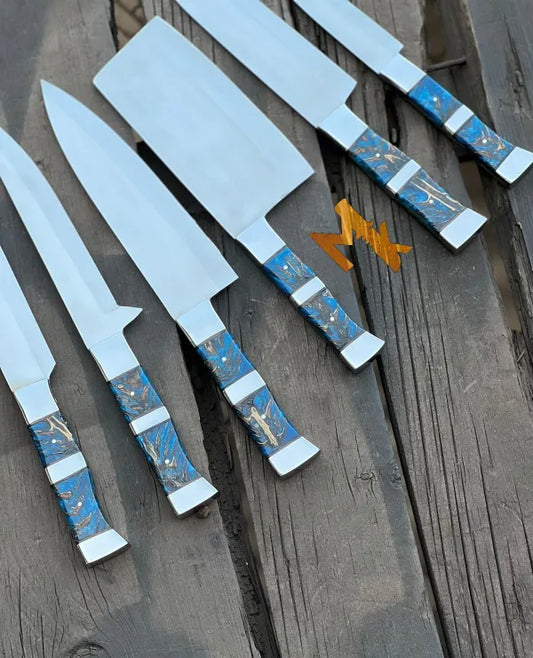
- Handles: camel bone, wenge wood, black and white resin, blue resin, G10
- Leather knife roll or carrying case included with every set
- Carbon steel, not stainless. Hand wash and dry, never the dishwasher
Who makes these knives?
Every blade is forged and finished by hand by us, Naqash and Younas Minhas, with more than 15 years of combined experience at the bench. We pattern-weld the Damascus billets ourselves, then forge, grind, heat treat, fit and finish each knife individually before the set is paired with a leather roll or case.
A matched set is harder than it sounds. Five knives from one billet have to share a pattern family, the handles have to be cut from the same block so the grain and colour agree, and the bolsters have to sit identically across all five. A stamped factory set has none of those constraints, which is why the price difference exists.
Read this before buying a Damascus kitchen knife
Most Damascus kitchen knives sold today are built on a stainless core, usually VG-10, AUS-10 or SG2, with the Damascus as cladding over the top. Those resist rust, shrug off acidic food and wash up like any stainless knife.
Ours are different, and you should know it before you buy. Our Damascus is forge-welded carbon steel, which means:
- It will patina. A grey-brown film develops with use. That is a stable oxide layer, it is normal, and it actually slows further corrosion. Many cooks prefer the look once it settles.
- It will rust if left wet. There is no chromium film protecting the surface. Dry it after every wash and it will not.
- Acidic food marks it fast. Onion, tomato, lemon and vinegar can leave a mark within minutes. Rinse and wipe between tasks rather than at the end.
- Never the dishwasher. Heat and detergent strip the oil, etch the blade and loosen a natural handle. A dishwasher will ruin one of these knives faster than years of cutting will.
- What you get in exchange: carbon steel takes a finer edge than stainless and comes back on a stone far more easily, and the pattern has depth that stainless cladding does not.
Straight answer on who should buy these. If you enjoy looking after your tools, they will outlast you. If you cook fast and leave things in the sink, buy a stainless-core knife instead and we will not be offended. Tell us what you cook through contact if you are unsure.
The blades in these sets, and what each one does
Kitchen knives are separated by geometry far more than by steel. A chef knife and a cleaver from the same billet do completely different work, because one has length and belly and the other has mass and a flat edge.
|
Blade |
Typical length |
Best at |
Weak at |
|
Chef |
8 inches |
The 80 percent knife: chopping, slicing, mincing, rock cuts |
Peeling, fine detail, bread |
|
Santoku |
7 inches |
Flat push cuts, vegetables, a shorter chef alternative |
Rock chopping, long slices |
|
Slicer / carving |
8 to 10 inches |
Long clean slices through roasts and proteins |
Chopping, anything on a board needing force |
|
Cleaver |
6 to 7 inches |
Mass work, squash, poultry joints, scooping from the board |
Precision, delicate produce |
|
Utility |
5 to 6 inches |
The in-between jobs a chef knife is too big for |
Large produce, long slices |
|
Bread |
8 to 10 inches, serrated |
Crust without crushing crumb |
Everything else |
|
Paring |
3 to 4 inches |
In-hand work, peeling, coring, trimming |
Board work of any size |
If you only use two knives, they will be the chef and the paring. Every set here includes both, which is deliberate. The cleaver, bread knife and slicer are the ones people either use constantly or never touch, so choose a set on whether those three earn their place in how you actually cook.
Which set is right for you?
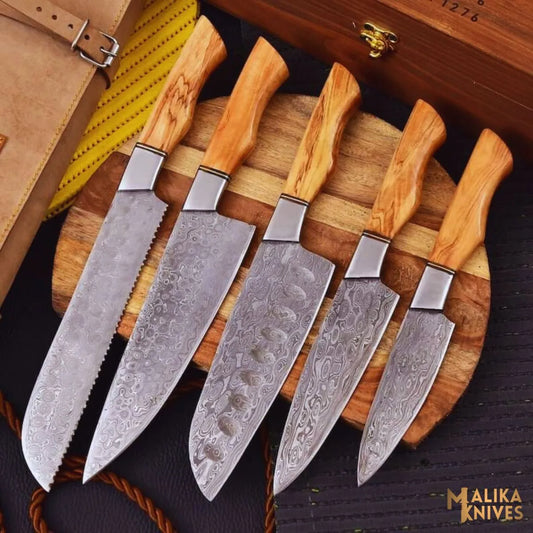
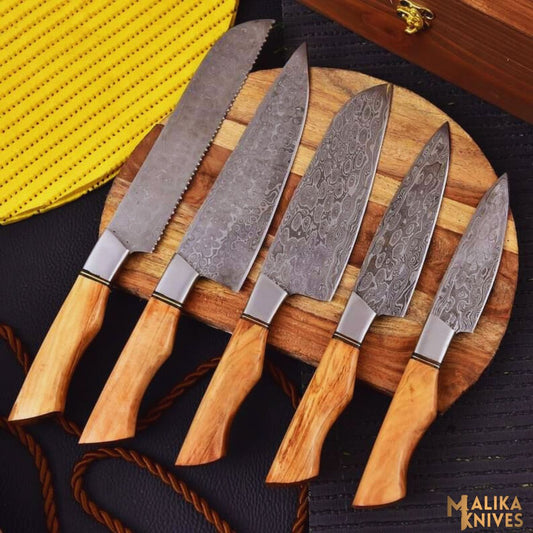
- Most cooking, broadest coverage. The 5-piece all-in-one set with wenge handles and a leather roll. Bread, chef, slicer, utility and paring, which covers everything except heavy cleaver work.
- You want the nicest-looking set. The 4-piece camel bone set with brass bolsters. Chef, santoku, paring and carving. Natural handle material, and the piece people comment on.
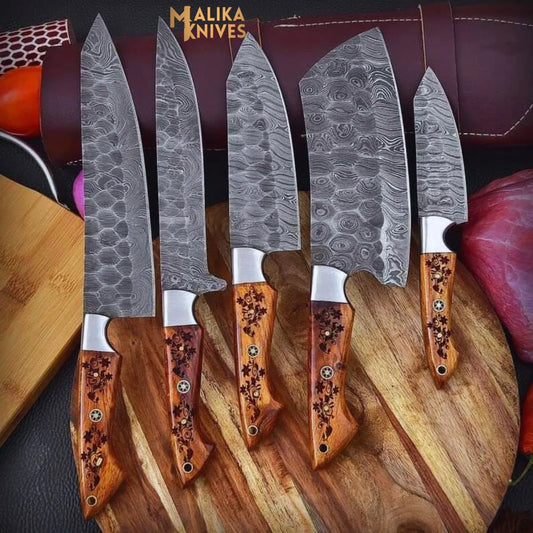
- You break down squash and poultry. The 5-piece set with blue resin handles, which includes a cleaver.
- Grip that holds when wet. Any set with resin or G10 handles over camel bone or wenge. Wet hands and a thin blade are the combination worth respecting.
- Lowest entry price. The Damascus set at the bottom of the range.
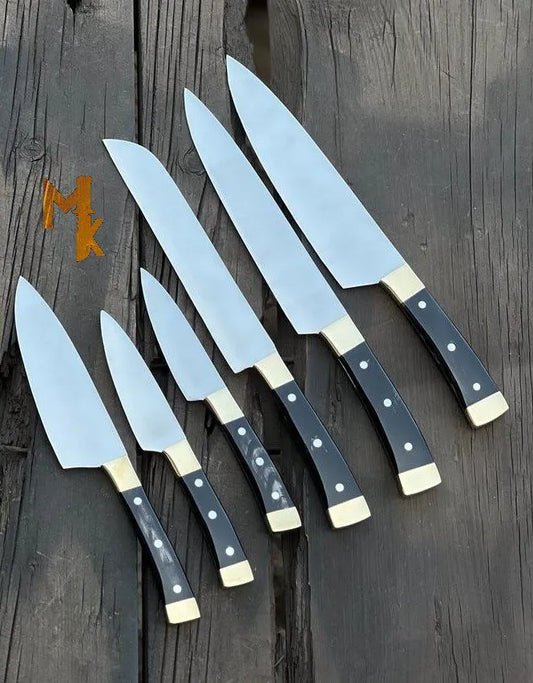
- A wedding or housewarming gift. The black and white set with a leather carrying case. Presentation case, matched handles, and nothing else in a kitchen looks like it.
Caught between two? Send us both through contact and we will tell you which one we would keep.
What steel are these, and how hard?
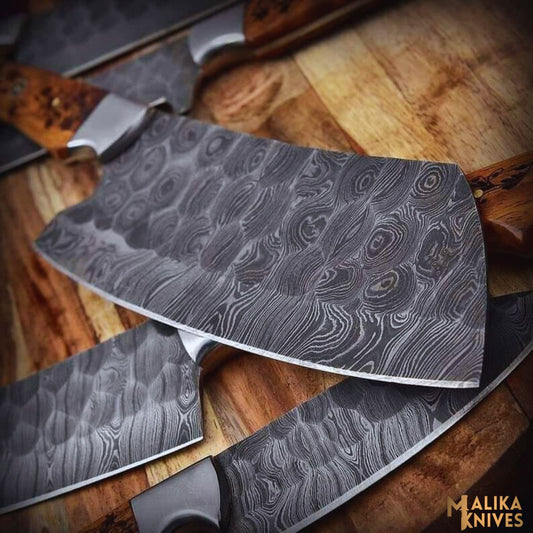
Our Damascus is forge-welded from two carbon steels, folded to build hundreds of layers, then etched so the layers show as a flowing pattern. One steel takes and holds the edge, the other resists the etch and appears bright against it, which is where the contrast comes from.
The composition and hardness figures go here. Across the knife trade, 58 to 62 HRC is the accepted target range for kitchen cutlery, hard enough to hold an edge and tough enough to resist chipping. Our field knives are stated at 59 to 60 HRC on the same billet construction. See note 3 before publishing.
On layer count. More layers do not make a better knife. Layering is aesthetic, and historically it was a way of working out impurities in less refined steel. Performance comes from the steels chosen and the heat treatment. Anyone selling a kitchen knife on layer count alone is selling appearance, which is a fine reason to buy as long as it is named as one.
How to tell forged Damascus from an etched pattern. On real pattern-welded steel the layers continue through the edge bevel and appear on the spine. A printed or etched pattern stops at the bevel and covers the flats only. Ask any seller to name the component steels and state a hardness figure. The vague "67-layer Damascus" with no core named is the standard red flag in this category.
Handle materials and balance
- Camel bone. Pale, dense, takes a fine polish. The traditional look and the one that photographs best.
- Wenge wood. Dark, close-grained and dense, with a texture that grips better than a polished handle.
- Resin, black and white or blue. Fully waterproof, dimensionally stable, and the easiest to keep clean around food.
- G10. Glass laminate. The hardest-wearing and grippiest option, used alongside wenge on one set.
The honest split for a kitchen. Resin and G10 are non-porous, wipe clean and hold grip with wet hands. Camel bone and wenge look considerably better and are slicker when wet. Wet hands on a thin sharp blade is the main risk in a kitchen, so if the set is going to be used hard and daily, take resin or G10. If it is a gift or a display-and-occasional-use set, take the camel bone.
All handles here are sealed and non-porous at the surface. Rinse and dry the handle along with the blade rather than leaving food residue in the join between scale and tang.
Sharpening and care
Kitchen knives are sharpened at a shallower angle than field knives, because they cut soft food on a board rather than hide and rope.
- Work at roughly 12 to 15 degrees per side. Field and hunting blades take 20 degrees for durability. A kitchen blade at 20 degrees will feel dull even when it is technically sharp.
- Use a whetstone. Coarse to set the bevel, fine to refine. Carbon Damascus comes back easily and does not need diamond plates.
- Chase the burr, flipping sides until it is gone, then finish with light strokes on leather.
- Hone between sharpenings rather than sharpening often. Less steel removed means a longer life.
Daily care takes under a minute:
- Hand wash in warm water, dry immediately. Never the dishwasher.
- Wipe between acidic tasks, not at the end of them.
- Oil before storage if the knives will sit unused for weeks. Food-safe mineral oil.
- Store in the roll or on a magnetic strip, not loose in a drawer where the edges knock together.
- Never abrasive polish or a scouring pad. Both strip the etch and flatten the pattern permanently.
- Cut on wood or plastic. Glass, stone and ceramic boards destroy an edge in one use.
Our Damascus care guide covers the routine in full, and the sharpening guide covers technique, with the angle adjusted as above for kitchen use.
Frequently asked questions
Are Damascus kitchen knives good?
Yes, with a caveat about which kind you buy. Performance comes from the core steel and heat treatment rather than from the pattern. A well-forged Damascus blade cuts as well as a good single steel at the same hardness and costs more because of the labour in forge-welding and folding. What you pay extra for is the pattern.
Are these knives stainless?
No. Ours are forge-welded carbon steel, unlike most Damascus kitchen knives sold today, which use a stainless core such as VG-10 or AUS-10 with Damascus cladding. Carbon takes a finer edge and sharpens more easily, and it needs hand washing and drying.
Will they rust?
Only if left wet. There is no chromium film protecting a carbon blade. Dry after every wash and the knife develops a grey patina instead, which is a stable oxide layer that slows further corrosion. Orange rust sitting proud of the surface is the one to act on.
What hardness are the blades?
The accepted target range for kitchen cutlery across the trade is 58 to 62 HRC, hard enough to hold an edge and tough enough to resist chipping on bone or frozen food.
What angle should I sharpen at?
Roughly 12 to 15 degrees per side for kitchen use. Hunting and field knives take about 20 degrees, which trades keenness for durability. A kitchen blade sharpened at a field angle will never feel properly sharp.
Does the number of layers matter?
No. Layering is aesthetic, and historically a way to manage impurities in less refined steel. A blade's performance comes from the component steels and the heat treatment. Layer count is a marketing number in the kitchen knife category.
Which knives do I actually need?
A chef knife and a paring knife cover most of what happens in a home kitchen, and every set here includes both. A bread knife matters if you buy crusty loaves. A slicer matters if you cook roasts. A cleaver matters if you joint poultry. Choose the set on those three.
Do the sets come with a case?
Yes. Every set includes a leather knife roll or carrying case, made to fit that set. The roll is also the best place to store the knives, since loose in a drawer the edges knock against each other.
Can I order a custom set?
Yes. Piece count, blade lengths, handle material, bolster style and case finish are all specifiable, and a set can be engraved. Send us what you have in mind through contact and we will tell you what is achievable and what it costs.
