
Few objects capture the imagination like the Viking axe. For the Norse it was both a tool and a status object, carried on campaign, buried in graves, and marked with runes and protective signs. Our handmade Viking axes carry that forward: hand-forged 1075 carbon steel heads, hand-carved wooden handles, and engraved Norse and Icelandic motifs. Ten in stock from $180, most with a tooled leather edge sheath.
-
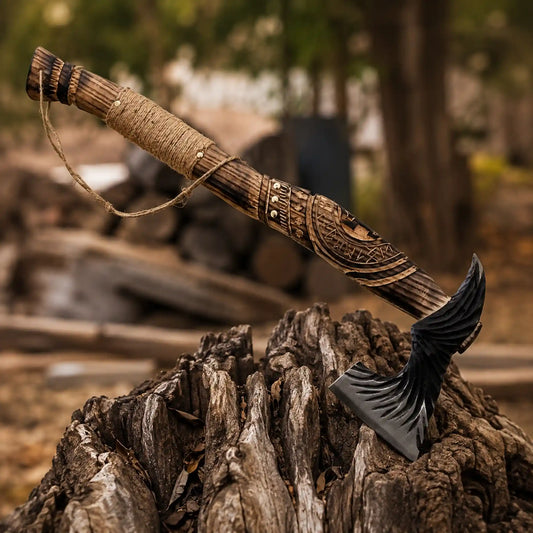
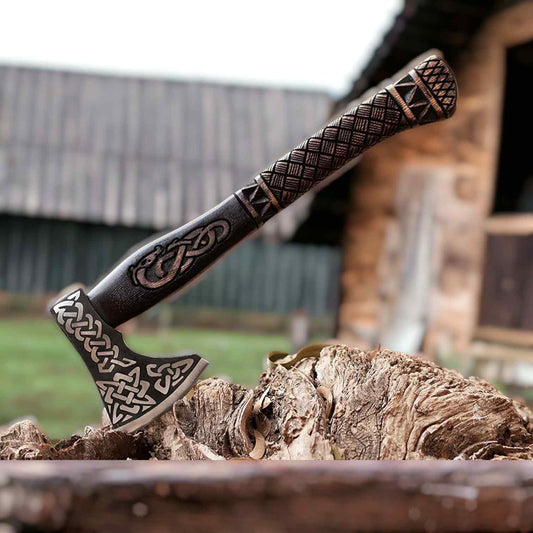
Raven Feather Viking Axe – Hand-Forged 1075 Steel Bearded Axe, Carved Rope-Wrapped Handle
Regular price $180.00 USDRegular priceUnit price per$360.00 USDSale price $180.00 USDSale -
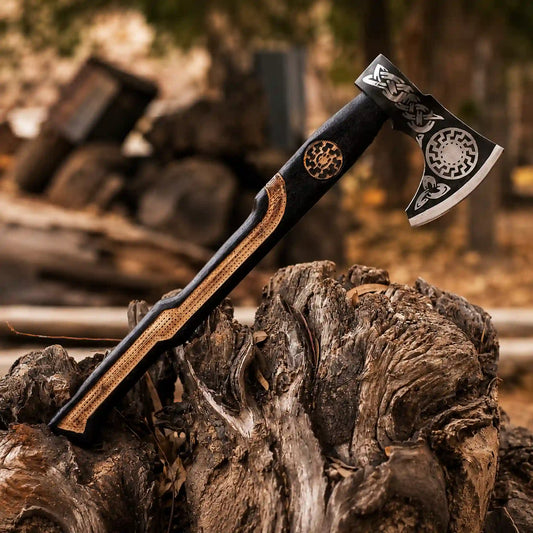
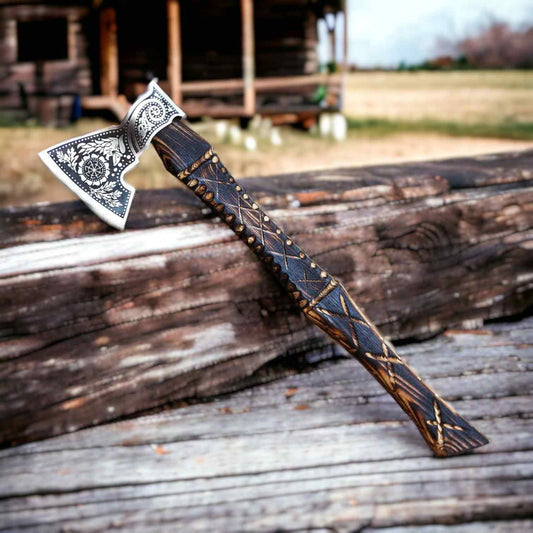
Sunwheel Viking Axe – Hand-Forged Bearded Axe with Inlaid Ash Handle
Regular price $250.00 USDRegular priceUnit price per$500.00 USDSale price $250.00 USDSale -
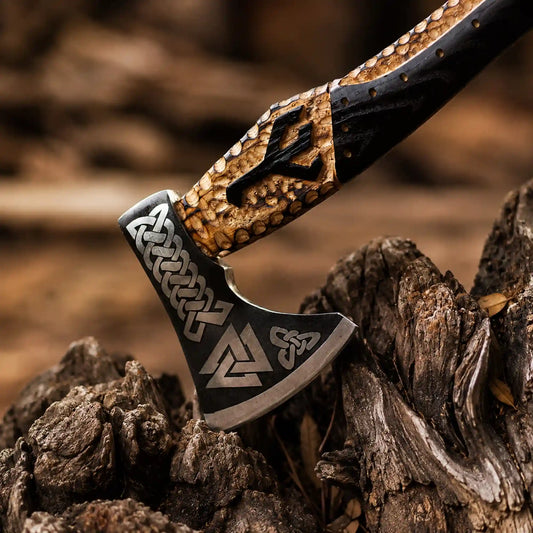
Valknut Viking Axe – Hand-Forged 1075 Steel Bearded Axe, Carved Ash Handle
Regular price $250.00 USDRegular priceUnit price per$500.00 USDSale price $250.00 USDSale -
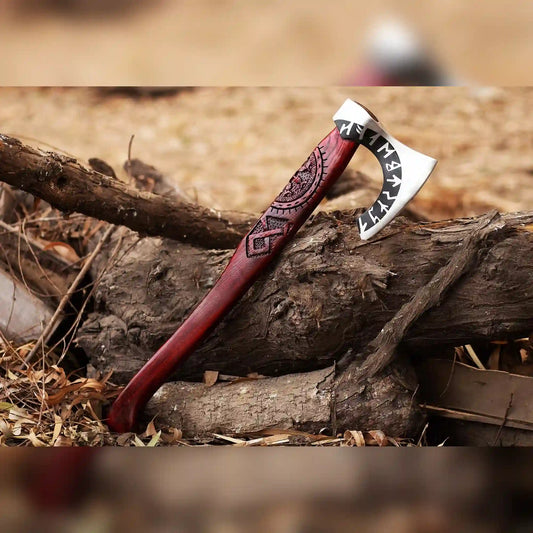
Runic Viking Axe – Hand-Forged 1075 Steel Bearded Axe with Long Ash Handle
Regular price $235.00 USDRegular priceUnit price per$470.00 USDSale price $235.00 USDSale -
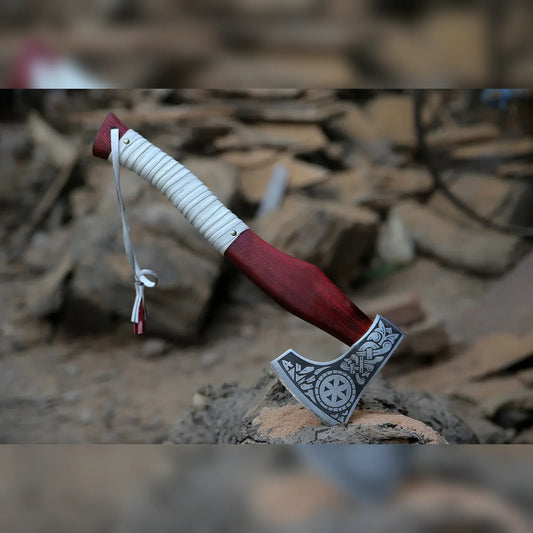
Kolovrat Sunwheel Viking Axe – Hand-Forged Bearded Hatchet, Leather-Wrapped Handle
Regular price $199.99 USDRegular priceUnit price per$400.00 USDSale price $199.99 USDSale -
Norse Serpent Viking Axe – Hand-Forged 1075 Steel Bearded Axe, Rosewood Handle
Regular price $210.00 USDRegular priceUnit price per$420.00 USDSale price $210.00 USDSale -
Raven & Sunwheel Viking Axe – Hand-Forged 1075 Steel Bearded Axe, Ash Handle
Regular price $230.00 USDRegular priceUnit price per$460.00 USDSale price $230.00 USDSale -
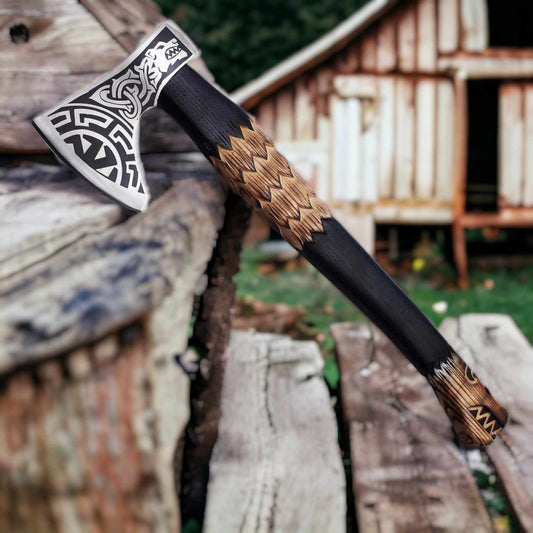
Norse Wolf Viking Axe – Hand-Forged 1075 Steel Bearded Axe with Ash Handle
Regular price $225.00 USDRegular priceUnit price per$450.00 USDSale price $225.00 USDSale -
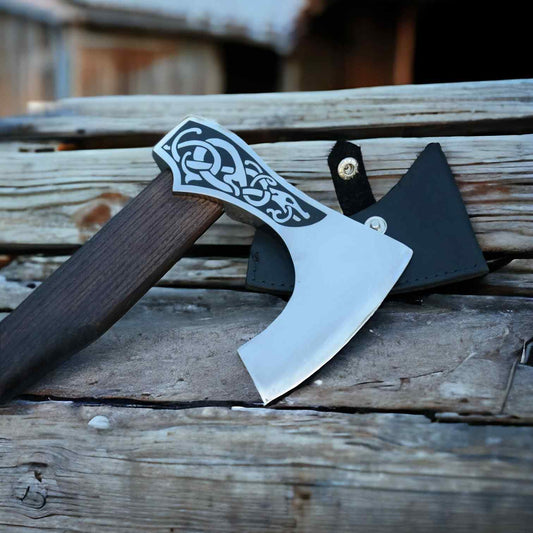
Celtic Knotwork Viking Axe – Hand-Forged Bearded Battle Axe with Carved Handle
Regular price $220.00 USDRegular priceUnit price per$440.00 USDSale price $220.00 USDSale -
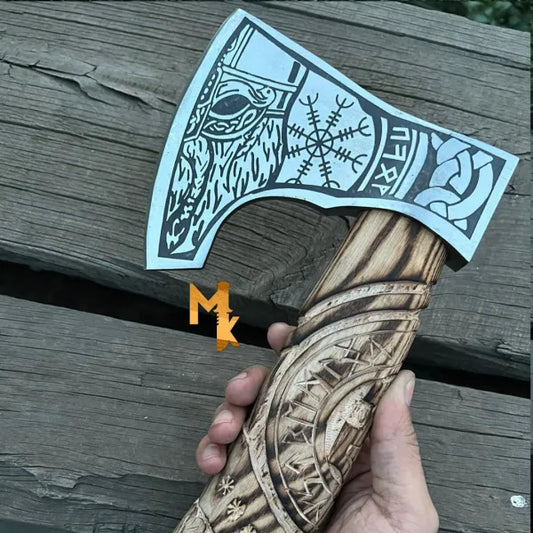
The Helm of Awe: A Mighty Viking Axe for Warriors
Regular price $180.00 USDRegular priceUnit price per$210.00 USDSale price $180.00 USDSale










Quick facts:
- 1075 carbon steel heads
- Bearded axe profile throughout, the pattern the Norse actually used
- Handles: carved ash, red ash, rosewood, leather-wrapped, rope and twine-wrapped
- Engraved motifs: raven, wolf, serpent, Valknut, sunwheel, Helm of Awe, Vegvísir, Celtic knotwork, runes
- Tooled leather edge sheath with most models
- Each one engraved individually, so no two are alike
Who makes these axes?
Every axe is made by hand by us, Naqash and Younas Minhas, with more than 15 years of combined experience at the bench. We forge each head, shape and carve each handle, and etch the Norse symbols individually, so no two axes are exactly alike. Whether you are a collector, a re-enactor, drawn to Norse history, or simply drawn to the craft, a handmade Viking axe is a piece with real presence.
An axe is a different engineering problem from a knife. A knife carries load along its length; an axe delivers it through one point at speed, and the eye where the handle passes through the head is where that force concentrates. Forging the eye rather than casting it, and wedging the handle tight, is most of what separates an axe you can use from an axe you hang up.
What makes a Viking axe
The classic Viking axe is defined by its shape. Most feature a bearded axe head, a blade with a lower cutting edge that extends down into a "beard", which lengthens the cutting surface while keeping the head light and fast. Viking axes ranged from small one-handed axes to the large two-handed Dane axe, and many carried carved or engraved symbols for protection and identity.
Why the beard exists, in practical terms. Three reasons, and none of them is decoration:
- More edge for the same weight of steel. A long cutting surface on a light head means it cuts efficiently without being heavy to swing, which matters over a long day.
- You can choke up behind the beard and grip the handle directly under the head for carving and controlled cuts. A straight-bit axe gives you nowhere to put your hand.
- The lower corner hooks. The extended point can pull and draw as well as chop, which is useful in shaping work.
The trade is that the beard is the thinnest section of the head, so it is what suffers if the axe meets a knot at speed or the ground.
How a Viking axe compares to other patterns:
|
Pattern |
Head |
Best at |
Weak at |
|
Bearded (Viking) |
Light, long edge, extended lower corner |
Limbing, shaping, carving, kindling |
Splitting rounds |
|
Felling axe |
Symmetrical bit, long handle |
Cutting across the grain |
Precision, splitting |
|
Splitting axe or maul |
Thick wedge |
Bursting rounds apart along the grain |
Cutting across grain, any fine work |
|
Hatchet |
Short handle, any bit shape |
One-handed camp work |
Reach and power |
If your intent is firewood rather than display and shaping, a splitting axe is the right tool and a bearded axe is the wrong one. Worth saying plainly.
Norse and Icelandic symbols, and what they mean
Part of what makes a Viking axe special is the symbolism, and the symbols on these heads each have a real history.
|
Symbol |
Origin |
Meaning |
Period |
|
Raven |
Norse |
Odin's ravens Huginn and Muninn, thought and memory, who flew the world and reported back |
Viking age |
|
Wolf |
Norse |
Odin's wolves Geri and Freki, and separately Fenrir, bound until Ragnarök |
Viking age |
|
Serpent |
Norse |
Jörmungandr, the world serpent encircling Midgard, biting its own tail |
Viking age |
|
Valknut |
Norse |
Three interlocked triangles found on Viking-age memorial stones, associated with Odin and with the slain |
Genuinely Viking age |
|
Runes |
Norse and Germanic |
The Elder and Younger Futhark alphabets, used for writing, memorials and inscriptions |
Viking age and earlier |
|
Celtic knotwork |
Insular Celtic |
Continuous interlaced strands, widely read as continuity and interconnection |
Early medieval |
|
Sunwheel |
Slavic and Norse |
A solar wheel found across many ancient European cultures. See the note below |
Ancient, many cultures |
|
Helm of Awe (Ægishjálmur) |
Icelandic |
Eight tridents radiating from a centre, a protective sign |
Later Icelandic, not Viking age |
|
Vegvísir |
Icelandic |
A wayfinder sigil, said to keep the bearer from losing their way in bad weather |
Later Icelandic, not Viking age |
Carbon steel heads and carved wood handles
We forge these heads from 1075 carbon steel, which takes a keen edge and holds up to real use. The handles are hand-carved wood, often finished with rope or cord wrapping for grip and a period look.
Why 1075 and not something harder. An axe head absorbs repeated shock at the edge, which makes toughness more important than maximum hardness. A head that is too hard chips on impact instead of deforming slightly and recovering. 1075 sits in the range where it takes a keen edge, holds it reasonably, and survives being driven into wood thousands of times. Harder, more wear-resistant steels such as D2 make excellent knives and poor axes for exactly that reason. Note that we have deliberately not used Damascus on these heads, because weld lines in a component that takes heavy shock is the wrong engineering choice. See Damascus steel axes if you want a layered head as a display piece.
Handle Materials
. Ash is the traditional axe handle wood and still the best general choice, because it is springy along the grain and absorbs shock rather than sending it into your wrist. Rosewood is denser and darker, holds a finish beautifully, and transmits a little more shock. Grain direction matters as much as species: on a good handle the growth rings run in line with the swing, so the wood flexes rather than splitting.
Several of these handles are deeply carved, which looks superb and removes a little wood. For heavy repeated chopping, the plainest ash handle is the more durable choice. For display with occasional use, the carving is the point.
Which Viking axe is right for you?
- The most striking head here. The Raven Feather bearded axe, where the head is sculpted into feather texture rather than surface engraved.
- Longest reach and most cutting power. The Runic axe with a long ash handle. More handle means more head speed and more work per swing.
- The most handle work. The Sunwheel with an inlaid two-tone ash handle or the Valknut with carved ash, both at the top of the range.
- Most historically defensible motif. The Valknut, which is genuinely Viking age, unlike Vegvísir and the Helm of Awe. Matters if you re-enact.
- Shortest and most controllable. The Kolovrat bearded hatchet with a leather-wrapped handle. Less power, more control, and the wrap grips well in the cold.
- A darker, more traditional look. The Norse Serpent with rosewood. Rosewood instead of pale ash changes the whole character.
- Norse mythology done properly. The Norse Wolf or the Raven and Sunwheel.
- Celtic rather than Norse. The Celtic Knotwork with a dragon-carved handle.
Caught between two? Send us both through contact and we will tell you which one we would keep.
Care and sharpening
1075 is carbon steel and the handle is wood, so both want a little attention.
The head:
- Wipe dry after use, including after green wood, which is wet and mildly acidic.
- Apply a light film of mineral oil or paste wax before storage. A grey patina is normal and protective; orange rust sitting proud of the surface is not.
- Keep the edge sheathed. Most damage to an axe edge happens in storage and transport, not in use.
- Never use abrasive polish on an engraved head. It fills and flattens the engraving permanently.
The handle:
- Oil the wood once or twice a year with boiled linseed oil or a hard wax. Dry wood shrinks, and a shrunken handle loosens in the eye.
- Check for looseness before every use by holding the handle and tapping the poll. A head that moves needs re-wedging before it is swung again.
- Store it at stable humidity. A radiator or a damp shed will both loosen a handle over a season.
- Sharpening. An axe takes a convex edge rather than the flat bevel you put on a knife, and a wider angle, roughly 25 to 30 degrees inclusive, because a thin edge chips on impact. Reprofile with a file, then work an axe puck or coarse-to-fine stone in circles following the curve of the bit, and finish on a strop. Give the beard extra attention, since it is the thinnest section and dulls first.
- A piece worth collecting
A handmade Viking axe makes a striking display piece and an unforgettable gift for anyone drawn to Norse history, mythology, or the craft of forging. Each one is individual, hand-forged, and etched with meaning. Browse our wider range of handmade blades, including our handmade Bowie knives and swords, the full hand-forged axe range, and our Damascus steel axes for a forged-pattern alternative.
Are axes legal to own and ship?
Axes are treated far more leniently than knives almost everywhere, because they are unambiguously tools.
United States. Legal to own throughout with no federal restriction. Transport in a vehicle is generally unproblematic; carrying one on the person in public falls under local ordinance, so keep it sheathed and stowed.
Canada. Legal to own. Prohibited weapon classifications turn on concealed or mechanical designs, which an axe is not. Transport sheathed.
United Kingdom and EU. Axes are legal to own and are not caught by the knife-specific provisions. Under UK law an axe is a bladed article for public carry purposes, so carrying one in public needs good reason such as work, bushcraft or transport to and from those activities, which is straightforward for a tool. Germany and some other countries restrict certain symbols by law, so see the sunwheel note above if you are ordering into the EU.
Rules change and none of this is legal advice. Verify the position where you live, and contact us if you want us to confirm what we can ship to your country.
Frequently asked questions about Viking axes
What is a Viking battle axe?
A Norse axe used as both a tool and a status object, typically featuring a bearded head with an extended lower cutting edge. They ranged from small one-handed axes to the large two-handed Dane axe, and were often marked with runes and protective symbols.
What is a bearded axe?
An axe whose head has a lower edge extending downward into a "beard". The design lengthens the cutting edge while keeping the head light, and it lets you grip just below the head for finer control. It is the classic Viking axe shape and the pattern used throughout this collection.
Are these real, functional axes?
The heads are hand-forged 1075 carbon steel with hand-fitted wooden handles, so the construction is sound rather than a soft cast replica. Several have deeply carved handles and engraved heads, which suits display and occasional use better than daily firewood work. If you want one for hard regular chopping, tell us and we will point you at the plainest-handled build.
What does the Helm of Awe mean?
The Helm of Awe, or Ægishjálmur, is eight tridents radiating from a centre, understood as a protective sign. Worth knowing that it comes from later Icelandic magical manuscripts rather than the Viking age, so it is Icelandic folk tradition rather than archaeological Norse.
What is the Vegvísir?
A wayfinder sigil said to keep the bearer from losing their way in rough weather. Like the Helm of Awe, it is recorded in 19th-century Icelandic manuscripts, specifically the Huld Manuscript of around 1860, rather than in the Viking age. Beautiful and widely wanted, and not archaeological Norse.
Which symbols here are genuinely Viking age?
The Valknut, ravens, wolves, serpents and runes are all genuinely Viking age and appear on Norse memorial stones and artefacts. Vegvísir and the Helm of Awe are later Icelandic. Celtic knotwork is early medieval Insular Celtic rather than Norse. Sunwheels are ancient and found across many cultures.
How do I care for a carbon steel axe head?
Wipe the head clean and dry after handling and apply a light coat of oil or wax before storage. A grey patina will form, which is stable and protective. Keep the edge sheathed in storage, and never use abrasive polish on an engraved head, because it flattens the engraving.
How do you sharpen an axe?
With a convex edge at a wider angle than a knife, roughly 25 to 30 degrees inclusive, because a thin edge chips on impact. Reprofile with a file, then use an axe puck or coarse-to-fine stone worked in circles along the curve of the bit, finishing on a strop. The beard dulls first.
Is a Viking axe good for splitting firewood?
No. A bearded axe has a thin bit built to cut across the grain, while splitting wants a thick wedge that bursts wood apart. Use one for limbing, shaping, carving and kindling, and a splitting axe or maul for rounds.
How do I stop the handle coming loose?
Oil the wood once or twice a year, store it at stable humidity, and check before every use by holding the handle and tapping the poll. Wood shrinks as it dries and a dry handle loosens in the eye. A head that moves must be re-wedged before it is swung.
Are these axes handmade?
Yes. Every one is forged, carved and engraved by hand by Naqash and Younas Minhas. Because each is made individually, no two are exactly alike.
Can I order a custom Viking axe?
Yes. Head size and profile, engraving, handle wood and length, carving and wrapping, and sheath tooling are all specifiable. Send us what you have in mind through contact and we will tell you what is achievable and what it costs.
